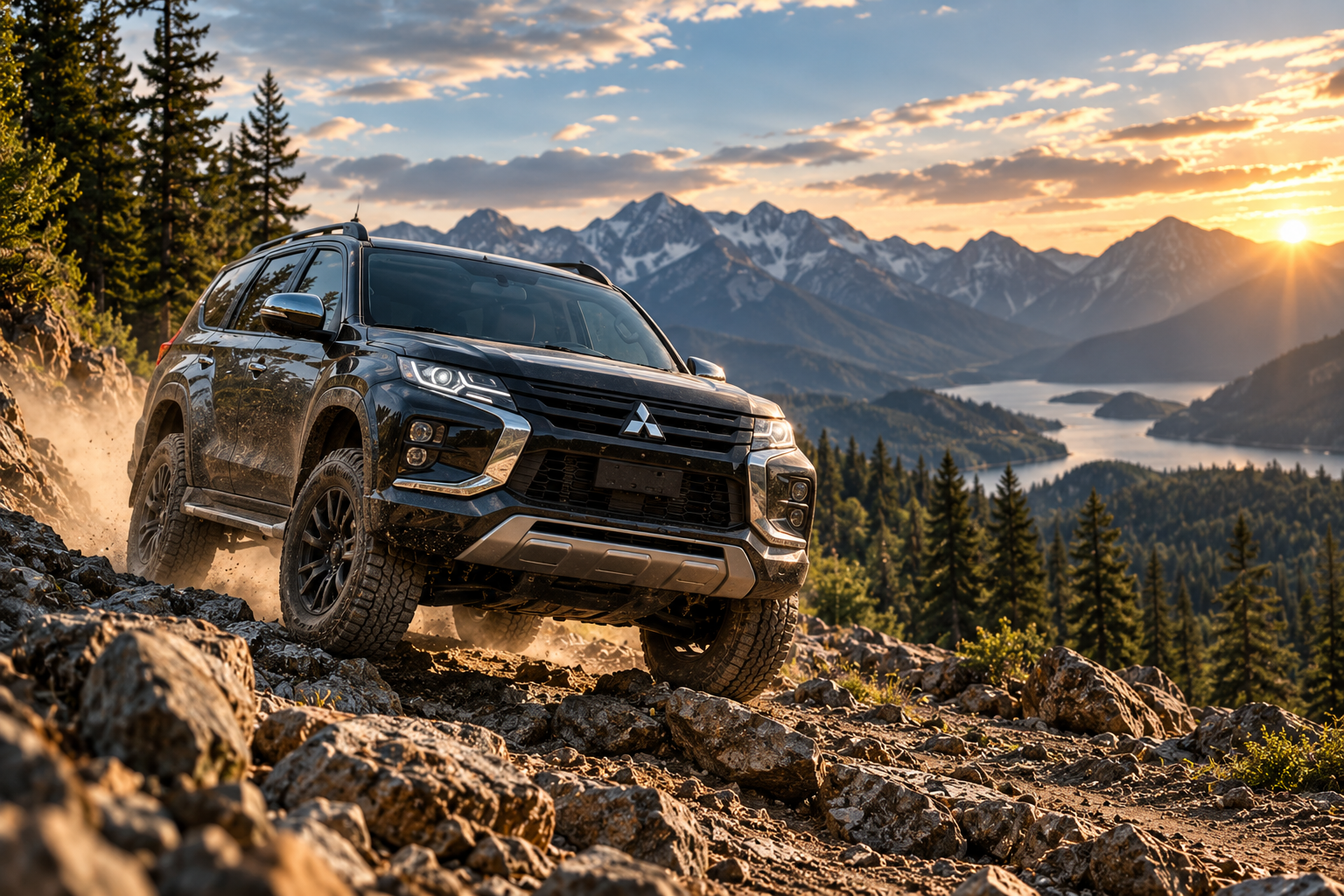
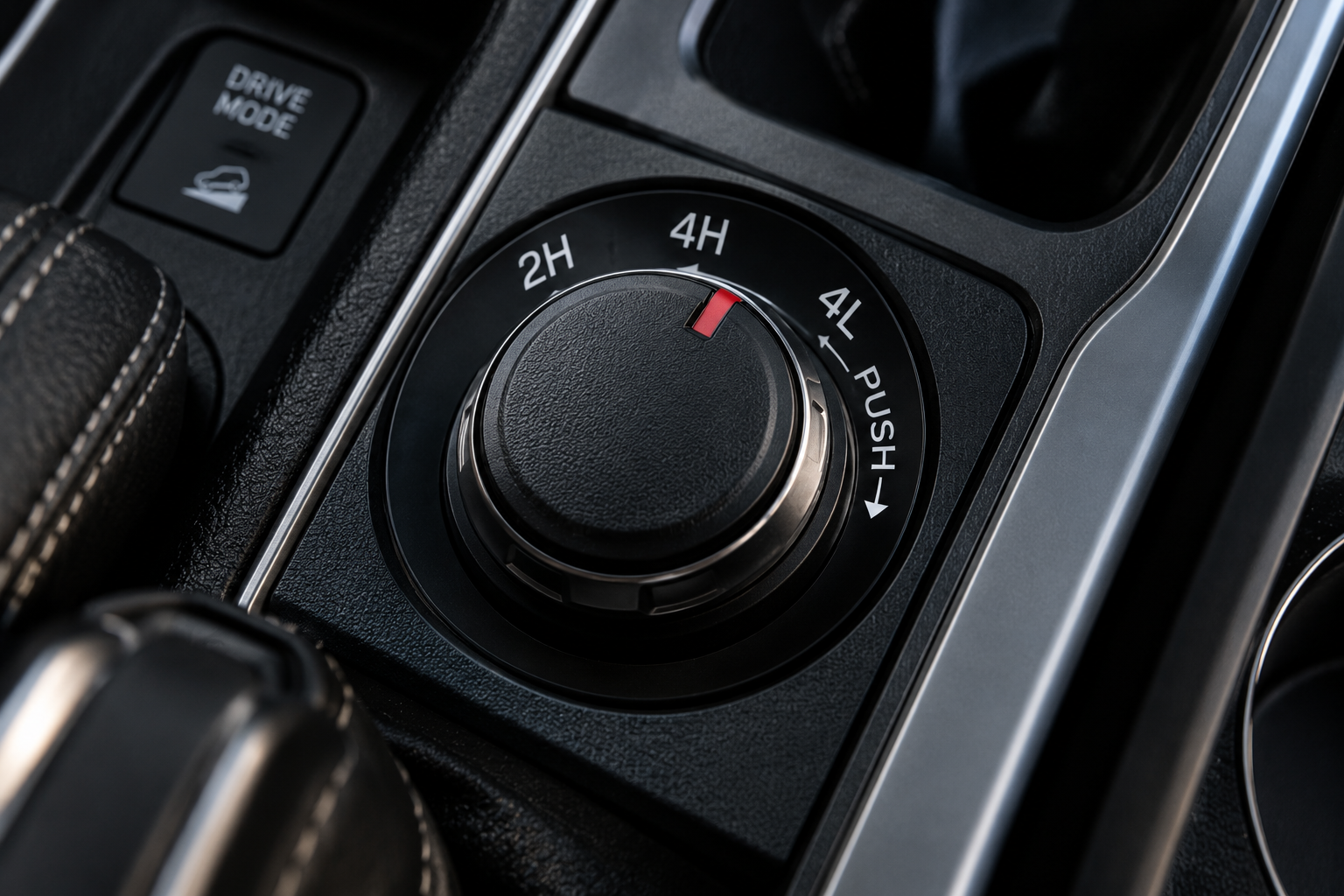
Four-wheel drive gives you more options when the trail gets difficult, but having 4H and 4L on the transfer-case selector does not automatically tell you when to use each one. Both modes can send power through the four-wheel-drive system, yet they are designed for very different situations. Choosing the wrong range can make an obstacle harder than it needs to be, increase wheelspin, or put unnecessary stress on the drivetrain. The useful distinction is simple: 4H is generally about maintaining traction while you still need normal vehicle speed, while 4L is about gaining control and torque multiplication when the terrain forces you to slow down.
What Is the Difference Between 4H and 4L?
The biggest difference between 4H and 4L is not simply how many wheels are being driven. The important change happens inside the transfer case. In high range, the drivetrain operates with gearing intended for relatively normal vehicle speeds. Low range adds gear reduction, so the engine can operate at a more useful rpm while the vehicle itself moves much more slowly. That reduction increases torque available at the wheels and gives the driver finer control over speed.
Think of the two ranges as tools for different jobs rather than two levels of the same setting. 4H is useful when traction is limited but momentum and moderate speed still matter. 4L becomes useful when speed itself is the problem and you need to crawl, climb, descend, or pull through resistance without relying on excessive throttle. Toyota’s Tacoma 4WD guidance describes 4H on its part-time system for surfaces that permit tire slip, while 4L is intended for maximum power and traction during conditions such as steep grades, sand, mud, and deep snow.
The practical differences can be summarized like this:
- 4H maintains a higher road-speed range while providing four-wheel-drive traction for loose, slippery, snowy, or off-road surfaces;
- 4L uses additional gear reduction to increase low-speed pulling ability and make throttle inputs easier to control;
- 4H is usually the better choice for flowing trails where conditions are loose but you are not crawling over obstacles;
- 4L is better suited to technical terrain where you want controlled wheel movement instead of speed and momentum;
- exact operating and shifting restrictions vary by vehicle, so the owner’s manual remains the final authority for your specific transfer case.
This distinction matters because more torque is not automatically better. If a dirt road is easy enough to travel at an ordinary trail speed, low range can make the vehicle feel unnecessarily busy and force you through gears quickly. Conversely, trying to tackle a slow technical climb in high range may require more throttle and clutch or transmission work than necessary. The goal is to select the range that lets the vehicle work comfortably at the speed the terrain demands.
When Should You Use 4H Off-Road?
4H is generally the first four-wheel-drive range to consider when leaving pavement and entering terrain with reduced traction. It allows the vehicle to keep moving at useful trail speeds while distributing drive through the 4WD system. That makes it well suited to gravel, dirt, moderate snow, loose surfaces, and many easier trails where you want additional traction but do not need the mechanical advantage of low-range gearing.
There is no reason to wait until the vehicle is already stuck before thinking about four-wheel drive. Selecting the appropriate mode before a loose climb, muddy section, or snowy trail can reduce unnecessary wheelspin and make the vehicle more predictable. The same principle applies to other aspects of trail preparation: choosing an appropriate line, understanding available ground clearance, and adjusting tire pressure for the terrain can matter just as much as the transfer-case position.
Typical situations where 4H can make sense include:
- Gravel and loose dirt roads. When the surface allows some tire slip and speeds remain relatively normal, high-range four-wheel drive can provide useful additional traction without forcing the vehicle into a crawling pace.
- Moderate snow or slippery trails. 4H can help when traction changes repeatedly but the route does not require extremely slow progress or maximum torque multiplication.
- Sand and loose terrain where momentum matters. Some conditions are easier with steady momentum than with extremely low gearing, although deep or difficult sand may eventually justify 4L.
- Rolling off-road trails. If you can comfortably drive the trail without excessive throttle, repeated wheelspin, or heavy braking on steep sections, 4H is often sufficient.
- Approaches to more difficult obstacles. High range can be appropriate for the easier sections between obstacles, with low range selected before entering terrain that requires crawling.
A common mistake is assuming that because 4L sounds more capable, it should be used for every unpaved road. It should not. A maintained forest road or open desert track may offer poor traction compared with pavement but still allow enough speed that low range provides little advantage. Using the least aggressive drivetrain setting that comfortably handles the terrain usually makes the vehicle easier to drive and leaves 4L available for the situations where its gearing actually helps.
When Should You Use 4L?
4L starts to make sense when the trail becomes slow enough that control matters more than speed. Low-range gearing lets the engine turn faster relative to vehicle speed, which can provide stronger wheel torque without requiring a large throttle opening. The vehicle can therefore move slowly through an obstacle while the driver makes smaller, more deliberate corrections. That is especially valuable on rocks, steep grades, deep ruts, difficult mud, and other terrain where sudden wheelspin can make the situation worse.
Low range can also reduce how hard the driver has to work the service brakes on steep descents because lower gearing can provide stronger engine braking, although the exact behavior depends on the powertrain and vehicle. On a difficult climb, the same reduction lets the drivetrain produce useful pulling force at low speed rather than relying on a fast approach. That does not mean 4L creates unlimited traction; the tires still need enough grip to transfer that torque to the ground.
Situations where switching to 4L is commonly useful include:
- steep climbs where maintaining a slow, controlled pace is preferable to attacking the hill with excessive momentum;
- steep descents where low gearing can help keep vehicle speed manageable and reduce dependence on continuous braking;
- rock crawling and ledges where precise tire placement and slow wheel rotation are more important than speed;
- deep mud, sand, or snow when the vehicle needs greater low-speed pulling ability to overcome resistance;
- deep ruts and uneven terrain where you need time to place the tires carefully and protect the underbody;
- recovery or hard pulling situations when the manufacturer permits low-range use for the task being performed.
Low range should not be confused with a guarantee that the vehicle will make it through an obstacle. Available traction, tire type, tire pressure, differential configuration, suspension travel, clearance, and driver technique still determine what happens at the contact patches. If the tires cannot grip the surface, additional torque may simply spin them faster. That is why 4L works best as part of a complete off-road strategy rather than as a substitute for choosing the right line and understanding the terrain.
Why 4L Gives You More Control, Not Just More Torque
Drivers often describe 4L as the “more torque” setting, but the improvement in control is arguably more useful. Gear reduction changes the relationship between engine speed and wheel speed. You can keep the engine in a responsive operating range while the tires rotate slowly enough to negotiate an obstacle deliberately. Instead of using a large throttle input to keep the vehicle moving, you can often feed in power more progressively and react before a small mistake turns into a hard impact or uncontrolled wheelspin.
This is particularly noticeable when climbing over rocks or through offset holes. In high range, maintaining enough engine speed may cause the vehicle to move faster than you want. The driver then alternates between throttle and brake inputs, which can make the vehicle less settled. Low range gives you a wider working window at crawling speed. The suspension has more time to articulate, the tires have more time to find grip, and the driver has more time to correct the line.
That slower pace also helps protect the vehicle. Ground clearance is only useful if you place the tires where that clearance can work for you. Charging through an obstacle can turn a manageable rock into an impact with a skid plate, differential housing, or rocker panel. Low range cannot increase the physical distance between the vehicle and the ground, but it can make it easier to use the clearance you already have effectively.
Should You Use 4H or 4L in Sand, Mud, and Snow?
Sand, mud, and snow are exactly where rigid rules about 4H versus 4L become unreliable. Two sections of sand can demand completely different techniques depending on depth and firmness. Mud can range from a thin slippery layer over a hard base to a deep hole that creates enormous rolling resistance. Snow can mean a few inches over gravel or a deep drift that pushes against the front bumper. The surface description alone does not determine the correct range.
A better approach is to think about the speed and effort required. If the vehicle can maintain controlled momentum without excessive wheelspin, 4H may be the better choice. If progress has slowed dramatically, the drivetrain is working hard, or you need precise control through deep material, 4L may become more appropriate. Tire pressure also changes the equation because reducing pressure within an appropriate off-road range can enlarge the contact patch and help the tire conform to loose or uneven surfaces.
Momentum deserves special attention. Low range produces more wheel torque, but some soft surfaces require enough forward speed to keep the vehicle from digging in. Selecting 4L and then applying too much throttle can produce aggressive wheelspin instead of progress. Likewise, staying in 4H and attempting to solve every problem with speed can lead to impacts or loss of control. The correct mode is the one that provides enough momentum without sacrificing control.
Can You Use 4H or 4L on Dry Pavement?
This question depends on the type of four-wheel-drive system installed in the vehicle. Traditional part-time systems can mechanically couple the front and rear drivetrains in a way that does not allow the speed difference needed when a vehicle turns on a high-traction surface. On dry pavement, where the tires cannot easily slip to relieve that difference, driveline windup can occur. That is why manufacturers commonly restrict locked part-time 4WD modes to loose or slippery surfaces.
Toyota’s guidance for the part-time Tacoma specifies 2H for normal driving on dry, hard-surfaced roads and 4H for surfaces that allow tire slip. Jeep likewise distinguishes between part-time and automatic/full-time operation. Jeep’s Wrangler 4x4 information shows why the distinction matters: depending on configuration, a Wrangler can offer modes such as 4H Auto in addition to a locked part-time four-wheel-drive mode.
This is why blanket advice such as “never use 4H on pavement” is incomplete. The correct statement is that you should not use a locked part-time four-wheel-drive mode on a high-traction surface unless the manufacturer explicitly permits it. A full-time or automatic 4WD system may operate differently. Always identify what your selector positions actually mean instead of assuming every vehicle labeled 4x4 uses the same transfer-case design.
How Do You Shift Between 4H and 4L?
There is no universal shifting procedure that applies to every four-wheel-drive vehicle. Some systems require the vehicle to be completely stopped before entering low range. Others specify a very low rolling speed with the transmission in Neutral. Electronic transfer cases may require the driver to hold a switch or wait for an indicator to stop flashing, while mechanical systems use a lever with their own operating procedure.
For example, the official Toyota instructions for the referenced Tacoma system specify stopping the vehicle, applying the brake, and placing the transmission in Neutral as part of the shift between 4H and 4L. Jeep systems can use a different procedure depending on the transfer case installed. Those differences demonstrate why copying another vehicle’s procedure is a bad habit and why the manufacturer’s manual should be checked before operating low range for the first time.
Before using low range for the first time, check these items in your own manual:
- the permitted vehicle speed for engaging or disengaging each 4WD mode;
- the required transmission position during a shift into or out of low range;
- whether the vehicle must be stopped or moving slowly;
- the meaning of flashing and solid 4WD indicator lights;
- the maximum recommended operating speed while in low range;
- any stability-control, traction-control, differential-lock, or terrain-mode changes that occur automatically.
If the transfer case refuses to shift, forcing the selector is rarely the right response. Confirm the required transmission position, vehicle speed, and indicator status first. Electronic systems may need the drivetrain to unload slightly before completing a shift. Again, the owner’s manual is more useful here than a universal internet procedure because the correct sequence is determined by the hardware and software installed in the specific vehicle.
Common 4H and 4L Mistakes
Most transfer-case mistakes come from treating four-wheel drive as an emergency button instead of planning ahead. Waiting until the tires are spinning halfway up a hill gives the drivetrain fewer options than selecting the appropriate mode on level ground before the climb. The same applies to low range: it is easier to engage it before a rock garden or steep descent than while the vehicle is already awkwardly positioned on the obstacle.
Another mistake is using throttle to compensate for the wrong range. If the vehicle needs a large throttle opening to crawl over an obstacle in 4H, low range may provide better control. If the engine is racing through gears on an easy dirt road in 4L, high range may be more appropriate. Listening to how hard the vehicle is working can be just as useful as looking at the terrain.
Finally, avoid assuming four-wheel drive overrides basic traction limits. A 4x4 with inappropriate tire pressure or poor tires can struggle where a better-prepared vehicle succeeds. Four-wheel drive changes how engine torque reaches the axles; it does not create grip between the tread and the ground. Good tire placement, sensible pressure, smooth inputs, adequate clearance, and knowing when to stop and reassess remain essential.
Conclusion: Choose the Range for the Speed the Terrain Requires
The easiest way to decide between 4H and 4L is to stop thinking of low range as simply “more four-wheel drive.” Use 4H when the surface is loose or slippery and you need additional traction while maintaining normal trail speeds. Consider 4L when the terrain forces you to slow down and you need greater torque multiplication, engine braking, or more precise control over wheel speed.
There will always be terrain that sits between those definitions, and that is where driver judgment matters. Start with the range appropriate for the speed you expect to maintain, pay attention to wheelspin and how hard the drivetrain is working, and switch before the vehicle becomes stuck or difficult to control. Most importantly, learn the exact transfer-case system in your own vehicle. Part-time, full-time, and automatic four-wheel-drive systems do not all follow the same rules, and the manufacturer’s instructions should always take priority over generic off-road advice.