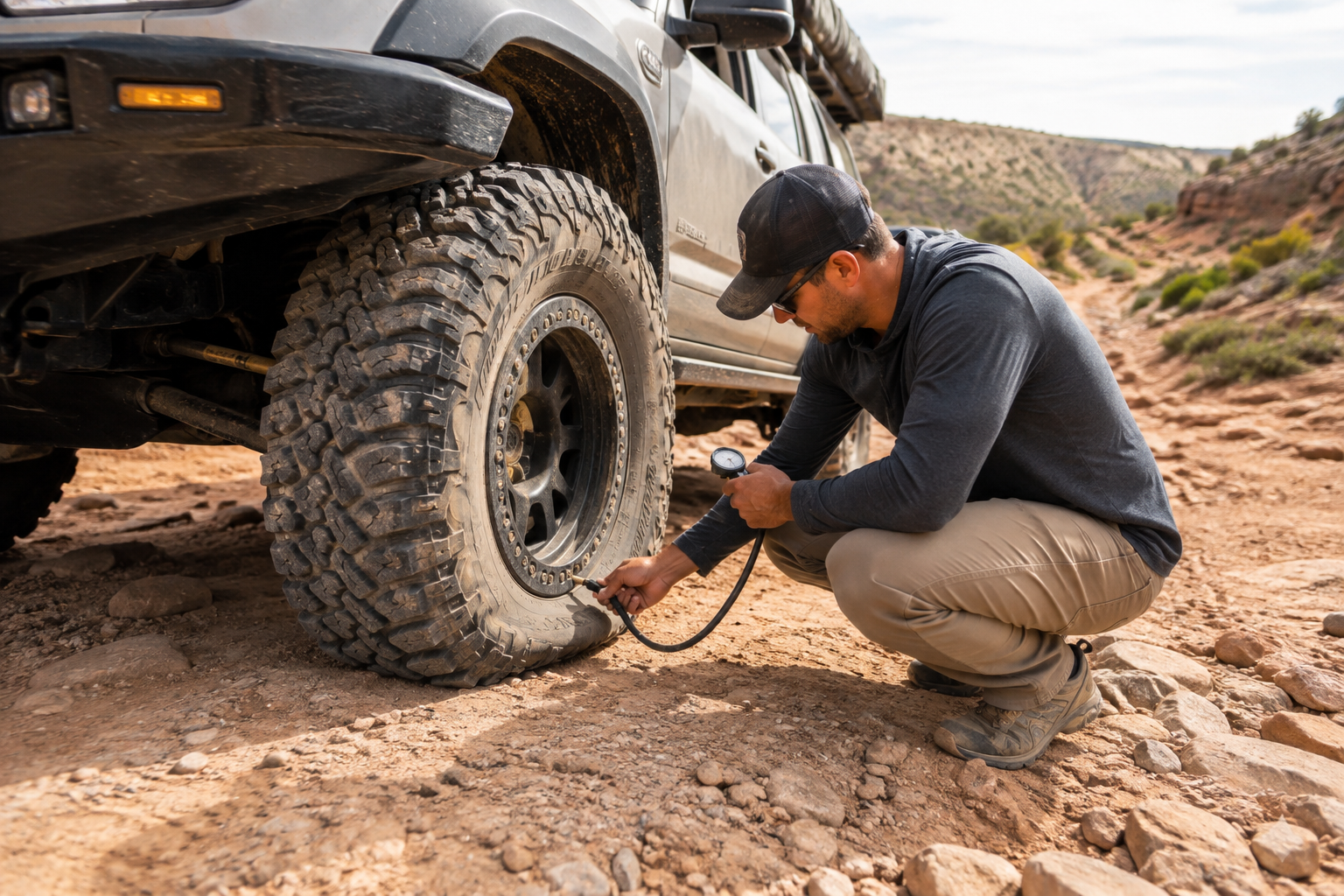
Tire pressure is one of the easiest things to change on an off-road vehicle, yet it can make a surprisingly large difference once the pavement ends. A truck that feels harsh, spins its tires, or struggles through loose terrain at normal road pressure may become noticeably more controlled after releasing some air. That does not mean lower is always better. Air down too little and you may not gain much traction. Go too far and you increase the risk of losing a tire bead, damaging a sidewall or wheel, and making the vehicle unstable. The correct pressure depends on the vehicle, tire, wheel, load, terrain, and how fast you plan to travel.
What Happens When You Air Down a Tire?
Reducing tire pressure allows the tire to flex more easily. The tread can conform to rocks and uneven surfaces instead of bouncing across them, while the contact patch becomes longer and provides more rubber against the terrain. On loose surfaces such as sand, the larger footprint can also help distribute the vehicle's weight across a greater area. Rather than digging into the surface as aggressively, the tire has a better chance of staying on top of it.
Airing down can provide several practical benefits:
- More traction. A larger, more flexible contact patch can grip rocks and loose surfaces more effectively.
- Better flotation. Lower pressure can help keep the vehicle from digging as quickly into sand and other soft terrain.
- Improved ride quality. Tires absorb more of the small rocks, roots, washboard, and trail irregularities.
- Less wheelspin. Better mechanical grip can reduce unnecessary spinning when climbing or crossing loose terrain.
- Better conformity over obstacles. A flexible tire can wrap around rocks rather than remaining rigid against them.
The improvement can be substantial, but every reduction in pressure also reduces the tire’s ability to support loads and protect the wheel. That tradeoff is why pressure needs to be adjusted deliberately rather than simply dropped as low as possible.
When Should You Air Down?
You usually do not need to lower pressure simply because the road is unpaved. A smooth gravel road driven at normal road speeds may not justify a major pressure change at all. Airing down becomes more useful when the terrain starts demanding additional traction or compliance. Deep sand, loose climbs, rocky trails, washboard, ruts, snow, and slow technical terrain are common situations where lower pressure can improve how a vehicle behaves.
A practical sequence at the trailhead looks like this:
- Check your current cold or road pressure. Know where you are starting before releasing air.
- Evaluate the terrain ahead. A maintained forest road does not require the same setup as deep sand or a rock garden.
- Lower pressure conservatively. Start higher rather than immediately targeting an aggressive low PSI.
- Drive a short section and evaluate the vehicle. Look at traction, ride quality, steering response, and tire deformation.
- Reduce pressure gradually if necessary. Small changes can produce noticeable differences.
- Reinflate before sustained paved-road speeds. Trail pressure is not highway pressure.
This approach is slower than copying somebody else’s number, but it gives you a pressure based on how your own vehicle actually responds.
How Far Should You Air Down?
For many conventional truck and SUV setups without beadlock wheels, the mid-to-high teens are a useful area to begin experimenting on slower off-road terrain. Depending on the vehicle and conditions, pressures may move higher or lower from there. Published off-road guidance commonly places sand and loose surfaces around 12–15 PSI, while rocks and mud may fall closer to 15–20 PSI. Other practical recommendations suggest approximately 14–18 PSI as a broad starting range for many normal off-road setups.
Those numbers should not be treated as targets that every vehicle must reach. A heavy full-size pickup carrying camping equipment may need more pressure than a light two-door SUV running the same nominal tire size. A tire with a tall sidewall behaves differently from a low-profile tire on a large wheel. Tire construction also changes how much the casing flexes at a particular pressure.
The goal is not to achieve the lowest PSI. The goal is to create useful tire deformation while retaining enough pressure to support the vehicle and keep the tire securely seated on the wheel.
Tire Pressure for Sand
Sand is one of the clearest examples of where airing down can transform a vehicle. At high pressure, a tire tends to present a smaller, firmer footprint. In deep sand that can encourage the tire to dig downward, particularly when the driver adds throttle after momentum begins to disappear. Lowering pressure lengthens the contact patch and spreads the load over more surface area. That improves flotation and can reduce the amount of wheelspin needed to keep moving.
Pressures around 12–15 PSI are commonly used as a general reference for loose sand, but vehicle weight and tire construction remain critical. Instead of immediately dropping to the bottom of the range, start conservatively and observe the sidewall. If the vehicle still digs excessively, a small additional reduction may help. If the tire begins folding heavily during turns or the steering becomes vague, you may already be too low for the setup.
Tire Pressure for Rocks and Technical Trails
Rocky terrain requires a slightly different strategy. Here, the main advantage of lower pressure is the tire’s ability to conform to the obstacle. A rigid tire may contact a rock over a relatively small area and then slip or bounce away. An aired-down tire can deform around part of the rock, increasing the available grip and making the vehicle easier to control at low speed.
For many conventional setups, roughly 15–20 PSI is a reasonable reference range for rocky trails. But as pressure drops, the wheel gets closer to the obstacle. Hit a sharp rock too aggressively and you can pinch or cut the tire, damage the sidewall, or strike the wheel itself. Very low pressure and high speed are a poor combination.
What About Mud, Gravel, and Washboard?
Mud is difficult to reduce to one pressure recommendation because mud itself varies so much. A shallow slick layer over firm ground behaves differently from a deep hole with a soft bottom. Moderate airing down can improve compliance and traction, and 15–20 PSI is often cited as a general reference. Gravel and washboard usually require less aggressive adjustments; if traction is already adequate, a moderate reduction may primarily improve ride quality.
Terrain should change your priorities:
- Sand: prioritize flotation and a larger footprint.
- Rocks: prioritize conformity and controlled traction.
- Mud: balance traction with the tire’s ability to clear material and maintain steering.
- Washboard: use additional compliance while maintaining enough pressure for speed and load.
- Mixed trails: choose a conservative compromise instead of chasing the ideal pressure for every obstacle.
If the trail changes repeatedly, a slightly higher all-around pressure is often more practical than running extremely low PSI for one short technical section.
Vehicle Weight Changes the Answer
One reason universal PSI recommendations fail is that tires support weight. A lightly loaded SUV and a full-size pickup carrying passengers, tools, recovery gear, water, fuel, and camping equipment place very different demands on their tires. Even if both vehicles run similar tire sizes, the heavier vehicle may need additional pressure to prevent excessive sidewall deformation.
Payload can also change during a trip. Watch the tire rather than relying only on the gauge. You want visible, controlled deformation—not a sidewall that appears to be collapsing beneath the vehicle. This is particularly important for overland builds, where permanent accessories can add hundreds of pounds before any trip equipment is loaded.
Wheel Size and Sidewall Height Matter
Two 35-inch tires do not necessarily respond the same way to airing down. A 35-inch tire mounted on a smaller-diameter wheel has more sidewall available to flex than a similar overall-diameter tire mounted on a large wheel. More sidewall generally gives the tire greater ability to deform over obstacles while maintaining some separation between the wheel and the terrain.
Large wheels with shorter sidewalls leave less room for that deformation. Dropping pressure aggressively can expose the wheel to impacts sooner and may increase the risk of bead problems. This is one reason trail-oriented builds often favor enough sidewall rather than choosing wheels primarily for appearance. If you are still deciding on the tire itself, see our AT, MT, or hybrid tire guide.
How Do You Know When the Pressure Is Too Low?
There is no warning light that tells you the perfect trail pressure has been crossed. You need to watch how the tire and vehicle behave. Some sidewall bulge is expected. Excessive folding is not.
Warning signs that you may have gone too low include:
- The sidewall folding dramatically during turns.
- Steering becoming unusually vague or delayed.
- The tire rolling noticeably under the wheel.
- Repeated contact between the wheel and rocks.
- Excessive heat building in the tire.
- Air escaping around the bead.
- The vehicle feeling unstable even at low trail speeds.
If you notice these symptoms, add air rather than trying to make the pressure work. The few minutes required to adjust pressure are far easier than reseating a tire bead or replacing a damaged wheel deep on a trail.
Can Beadlock Wheels Run Lower Pressure?
Beadlock wheels physically secure the tire bead to the wheel, reducing one of the major risks associated with very low pressure. Properly designed off-road beadlocks can therefore allow experienced drivers to use pressures that would be risky on conventional wheels. Some extreme rock-crawling setups operate in the single digits.
That does not mean beadlocks remove every limitation. Very low pressure still leaves less air between the wheel and the obstacle, increases sidewall deformation, and can expose the tire and wheel to impact damage. Vehicle handling also becomes progressively less precise as pressure falls. Use the additional capability when the terrain actually requires it.
Low Tire Pressure Means Lower Speed
Pressure and speed need to be considered together. At highway pressure, a tire is designed to carry its rated load while maintaining its shape through sustained speeds. Once significant air is removed, the sidewall flexes much more with every rotation. More flex creates heat. It also makes steering less precise and allows the tire to move more relative to the wheel.
That is acceptable during slow trail driving because speeds and loads generated by cornering are comparatively low. It becomes dangerous when the same tire is taken onto pavement and accelerated to normal road speeds. The more aggressively you air down, the more conservative your trail speed should become.
What Equipment Should You Carry?
Airing down only makes sense if you can reliably put the air back in. You do not need an elaborate onboard air system for casual trail use, but you should have equipment capable of measuring pressure accurately and reinflating all four tires before returning to the highway.
A basic tire-pressure kit should include:
- A reliable tire-pressure gauge.
- A manual or automatic tire deflator.
- A portable compressor capable of handling your tire size.
- Valve caps and preferably spare valve cores.
- A tire repair kit.
- A full-size spare when traveling remotely.
Automatic deflators can make the process faster, while a quality compressor is equally important because large off-road tires can take considerable time to reinflate. Test the equipment at home before depending on it miles from pavement.
Always Air Back Up Before the Highway
This is the part of airing down that should never be optional. A pressure that works well at 5 or 10 mph on a rocky trail may be completely inappropriate at highway speed. Low pressure allows excessive sidewall flex, generates additional heat, reduces steering precision, and can damage the tire during sustained road travel.
Before leaving the trail, reinflate the tires to the appropriate road pressure for your vehicle, load, and tire setup. Do not assume the nearest gas station is close enough. If you intentionally air down in a remote area, your own compressor should be considered part of the required equipment. Check all four tires afterward.
Finding the Right Pressure for Your Own Rig
The best off-road pressure is something you develop through controlled experimentation. Start conservatively. Record the vehicle’s normal road pressure and then make moderate reductions at the trailhead. Drive slowly, observe the footprint and sidewall, and pay attention to traction and ride quality. If the vehicle still feels unnecessarily harsh or struggles for grip, reduce pressure a little more and evaluate again.
Over several trips, you will begin developing useful baseline settings for your particular vehicle. You might eventually know that one pressure works well for ordinary rocky trails, another is better for deep sand, and a slightly higher setting makes sense when the truck is heavily loaded. That knowledge is more useful than copying a PSI number from a completely different build.
Conclusion
Airing down is one of the simplest and most effective adjustments you can make before taking a truck or SUV onto demanding terrain. Lower pressure can improve traction, increase flotation, soften the ride, and help the tire conform to rocks and uneven surfaces. But the goal is not minimum pressure.
For many conventional off-road setups, pressures somewhere in the mid-to-high teens provide a useful starting area, while sand may justify going lower and heavier vehicles may need to remain higher. Tire construction, wheel size, sidewall height, payload, speed, and terrain all influence the final number.
Start conservatively, make small adjustments, and watch how the tire actually behaves. Carry an accurate gauge and a compressor, and always restore appropriate road pressure before returning to pavement. The right trail pressure is not the lowest number your tires can survive. It is the pressure that gives your specific vehicle the traction and compliance it needs without sacrificing the support and protection the tire still has to provide.