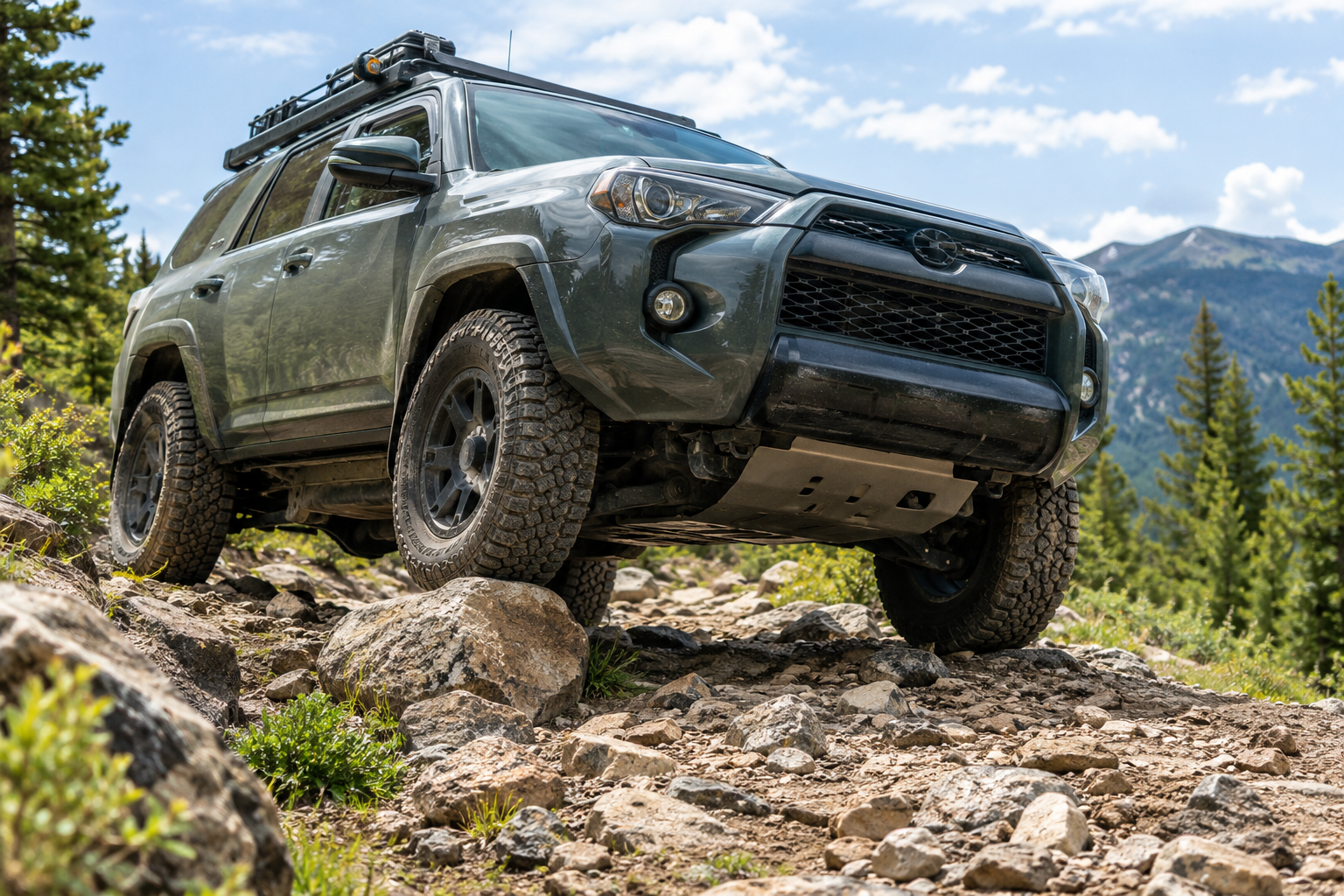
Ground clearance is one of the first numbers people look at when deciding whether a truck or SUV is ready for the trail. More space between the vehicle and the ground sounds like more room to clear rocks, ruts, roots, and uneven terrain. But once you leave a maintained dirt road, that single number stops telling the whole story. A vehicle with 10 inches of clearance can still drag its bumper or get hung up on a sharp crest, while another rig with slightly less clearance may walk through the same obstacle without touching anything. Wheelbase, tire size, overhangs, underbody components, suspension travel, and the line you choose all affect what actually clears.
What Ground Clearance Actually Measures
Ground clearance is generally measured between the ground and the lowest fixed point underneath the vehicle. Depending on the design, that low point may be a differential housing, axle component, exhaust section, crossmember, skid plate, or another part of the underbody. That distinction matters. A spec sheet might tell you a vehicle has respectable clearance, but it does not automatically mean every part underneath sits at that height. Nor does the number explain what happens when the suspension compresses, the vehicle is loaded with camping equipment, or one wheel drops into a rut.
Before taking a vehicle onto rougher trails, physically look underneath it. Pay particular attention to differentials and axle housings, skid plates and crossmembers, exhaust components, fuel tanks and drivetrain components, plus steps, running boards, and tow equipment. Knowing where those parts sit gives you a much more useful picture than memorizing one specification.
A Practical Ground Clearance Range for Different Trails
There is no universal minimum because “off-road” can mean anything from a maintained forest road to technical rock crawling. Still, some practical ranges can help you decide whether your current setup is appropriate.
A useful starting point looks like this:
- 6–8 inches — mild terrain. Suitable for maintained dirt roads, gravel, smoother two-tracks, and occasional shallow ruts.
- 8–10 inches — moderate trails. More appropriate when rocks, erosion, deeper ruts, and uneven surfaces become regular obstacles.
- 10+ inches — technical use. Useful for more serious trail work where larger rocks, sharp crests, and difficult terrain are expected.
These are guidelines, not guarantees. Ten inches under the wrong vehicle geometry can be less useful than nine inches under a well-designed trail rig. The goal is enough margin for the terrain you actually drive, not the biggest number you can build.
Why Approach, Departure, and Breakover Angles Matter
Ground clearance tells you how much room exists beneath a vehicle on relatively flat terrain. Off-road obstacles are rarely flat. When the trail suddenly rises, the first limitation may be the front bumper rather than anything underneath the center of the vehicle. That is where approach angle matters. A short front overhang allows the front tires to reach a steep obstacle before the bumper contacts it.
The same principle applies at the rear. Departure angle determines how steeply you can come off an obstacle without dragging the bumper, hitch, exhaust, or other rear-mounted equipment. Breakover angle becomes important when crossing a ridge or sharp crest. A vehicle with a long wheelbase can have plenty of nominal ground clearance and still become high-centered because the middle of the chassis reaches the crest while the axles remain on opposite sides. This is why two vehicles with identical ground-clearance specifications can behave very differently on the same trail.
Wheelbase Can Change Everything
Long-wheelbase trucks offer cargo room, stability, and often better comfort when carrying people and equipment. On sharp trail features, however, that extra distance between the axles can work against you. Imagine a short SUV and a long pickup, both with nine inches of clearance. As they cross a narrow ridge, the shorter vehicle gets its rear wheels closer to the crest sooner. The longer truck leaves the center of its chassis suspended over the high point for longer, increasing its chance of making contact.
With a longer wheelbase, good trail habits become especially important:
- Approach sharp crests at a controlled speed and avoid carrying momentum into a blind breakover.
- Watch the center of the vehicle rather than only the tires.
- Use a spotter when the obstacle cannot be seen clearly from the driver’s seat.
- Avoid unnecessarily straddling rocks that may contact the center underbody.
- Know which parts underneath the truck are protected and which are not.
A few inches of extra clearance cannot completely compensate for poor obstacle placement. Vehicle dimensions and line choice remain part of the equation on every technical section.
Do Bigger Tires Increase Ground Clearance?
Yes, and this is one reason tire size matters so much on off-road builds. But the gain is smaller than the diameter number might suggest. If you move from a 31-inch tire to a 33-inch tire, the tire diameter increases by two inches. Because the axle sits near the center of the wheel, that change raises the axle by roughly one inch, not two. That additional inch can be valuable because it raises components that a conventional suspension lift may not move farther from the ground.
Larger tires can also improve approach, departure, and breakover geometry, but they come with tradeoffs. Extra diameter and weight can affect gearing, braking, acceleration, steering feel, fuel economy, and clearance inside the wheel wells. The right tire upgrade is therefore not simply the largest size that physically fits. It should work with the gearing, suspension, intended terrain, and overall build. If you are still choosing a tread type, our AT, MT, or hybrid tire guide is the better place to start.
Does a Suspension Lift Solve the Problem?
A suspension lift can dramatically improve a vehicle’s trail geometry, but it is important to understand what is actually being lifted. On many solid-axle vehicles, lifting the suspension raises the frame and body relative to the axles. That can improve approach, departure, and breakover performance and create room for larger tires. However, the differential housing remains attached to the axle, so a suspension lift alone does not provide the same increase in differential clearance that taller tires do.
Lifting a vehicle also introduces compromises. A higher center of gravity can affect handling and side-slope confidence, while larger changes may require attention to alignment, driveline angles, brake lines, steering geometry, and other components. A well-planned off-road build treats lift height as one part of the system rather than the goal itself.
Ground Clearance Changes Once You Load the Vehicle
The clearance measured on an empty vehicle is not necessarily the clearance you will have at the trailhead. Add passengers, recovery equipment, tools, water, fuel, camping gear, a rooftop tent, and several days of supplies, and the suspension may settle noticeably. The rear of an overloaded truck can lose useful height, while the extra mass also changes how quickly the suspension compresses when a wheel hits a dip or ledge.
This is particularly important for overlanding builds, where equipment tends to accumulate over time. Before deciding you need a lift, look at the vehicle in its normal trail configuration. If it sits significantly lower when loaded, the real issue may be payload management, spring rate, or weight distribution rather than the factory ground-clearance specification.
Skid Plates Can Matter More Than Another Inch of Lift
You cannot realistically guarantee that the underside of a trail vehicle will never touch anything. The better strategy is to know which contacts are acceptable and protect the components that cannot afford a direct hit. That is where proper underbody armor becomes valuable. Skid plates can protect vulnerable areas such as the engine, transmission, transfer case, and fuel tank when the available clearance finally runs out.
More clearance helps you avoid contact. Armor helps manage the consequences when contact is unavoidable. For many practical trail builds, combining sensible clearance with good underbody protection is more useful than chasing maximum lift height. If your low points are exposed, read our skid plates and underbody armor guide before adding height just to solve a protection problem.
Driver Line Choice Is Part of Your Ground Clearance
A surprising amount of effective clearance comes from where you put the tires. Consider a rock sitting in the middle of the trail. A new driver may try to straddle it, placing the rock directly beneath the differential or another low point. An experienced driver may put a tire on the high side of the obstacle, raising that corner of the vehicle and moving the vulnerable components away from the rock.
Before committing to a difficult section, ask three questions:
- What is the lowest vulnerable point underneath my rig?
- Where will that point travel as the wheels move through the obstacle?
- Can I place a tire somewhere that creates more room?
Learning those answers can save more underbody damage than adding another inch of lift. Slow observation and deliberate tire placement are part of the vehicle’s usable clearance every time the trail gets tight.
So, How Much Ground Clearance Do You Need?
For mild forest roads and maintained dirt trails, you may already have enough. Around 6–8 inches can work when obstacles are modest and line choice is careful. For regular trail use involving rocks, deeper ruts, erosion, and uneven terrain, 8–10 inches provides a more comfortable margin. Once you move into genuinely technical terrain, 10 inches or more becomes increasingly useful.
But do not build around that number alone. A capable off-road setup combines adequate clearance with appropriate tires, useful approach and departure angles, manageable wheelbase, underbody protection, suspension suited to the vehicle’s loaded weight, and a driver who understands where the wheels need to go.
Conclusion
Ground clearance matters, but it is not a score that tells you whether a vehicle is “good” or “bad” off road. It is one part of a larger geometry problem. Before spending money on a lift, identify the actual low points underneath your vehicle, think about the trails you realistically drive, and consider what limits you first. Sometimes the answer is more clearance. Sometimes it is taller tires, better skid plates, improved suspension for a loaded rig, or simply a better line through the obstacle.
The best trail build is not necessarily the tallest one. It is the one that gives you enough clearance in the places that matter while keeping the vehicle predictable, protected, and usable everywhere else.