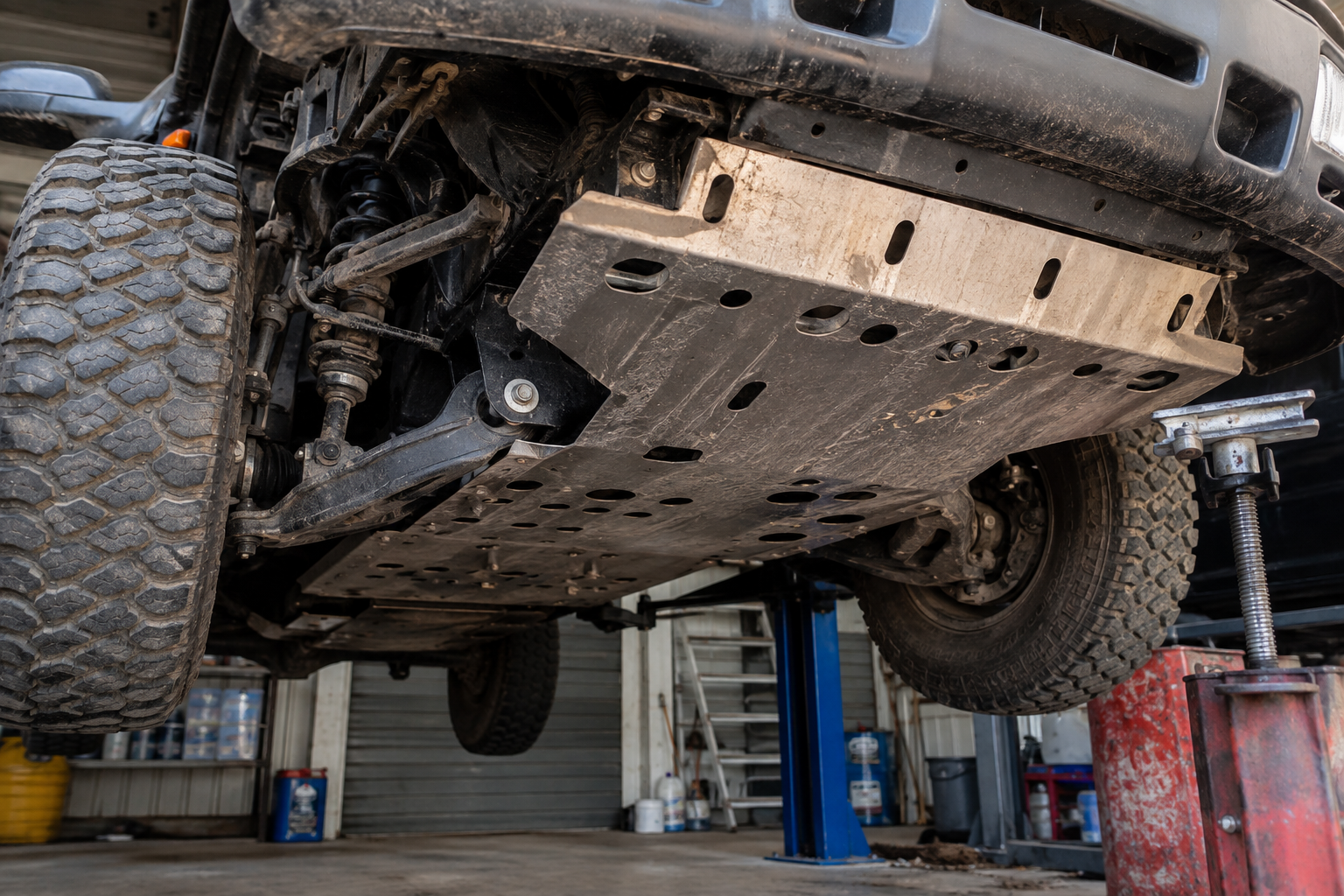
Underbody armor is the build category most likely to get bought wrong in both directions — a full skid plate kit on a truck that never leaves gravel roads, or a bare belly pan on a rig that's about to drag its transfer case over a rock ledge. The right amount of armor isn't a fixed number of plates, it's a match to the terrain the truck actually sees, the parts that are genuinely exposed when it gets there, and an honest read of what a repair bill actually costs versus what the armor costs up front.
What a Skid Plate Is Actually Stopping
A skid plate's job isn't to make the underside indestructible — it's to turn a direct impact into a glancing one. Factory ground clearance already protects most of the drivetrain on moderate trails; armor earns its keep specifically on the terrain where a rock, ledge, or rut sits exactly where a critical component hangs lowest.
That means the plate only matters if it's covering something that would otherwise take the hit directly — not just bolted on for the look of a protected underside. Most factory-fitted plates that come with off-road packages are thin steel or stamped composite, sized to satisfy a marketing checkbox rather than survive a real rock garden. Knowing that going in changes how you shop: the question isn't "does my truck already have a skid plate," it's "does the one it has actually do anything on the terrain I run."
FIG. 01 — WEAR PATTERN ON A PLATE THAT'S ACTUALLY WORKING
The Components Actually Worth Armoring
Not every part hanging low under a truck is equally vulnerable, and not every impact on those parts is equally expensive to fix. A truck's underside is a long list of components at wildly different heights, made from different materials, and carrying very different consequences if something punches through — treating them all as equally worth protecting is how people end up either underprotected where it matters or hauling around armor that's doing nothing.
Here's what's actually at stake if each of the usual suspects takes a direct hit:
Oil pan — thin stamped metal holding the engine's entire oil supply; a crack here means a slow leak at best and a seized engine at worst if it's not caught in time.
Transfer case — sits low by design on most 4x4s, and damage here can strand the truck in 4-low with no way to shift back out.
Fuel tank — usually the widest, lowest-hanging target on the whole underside, and the one failure mode nobody wants to deal with mid-trail.
Transmission pan and cooler lines — a puncture here drains fluid fast and can cook the transmission within minutes of continued driving.
Steering components — tie rods and steering boxes that hang low enough to catch a rock are a safety issue, not just a repair bill.
Catalytic converter and exhaust crossover — expensive to replace and, on some trucks, sits surprisingly close to the rocker line.
If the budget only covers one plate, it covers whichever of these hangs lowest on the specific vehicle — which varies enough by model that it's worth actually checking under the truck on a lift rather than assuming.
Steel, Aluminum, or Factory Composite: What the Material Actually Changes
The material argument comes up in every skid plate conversation, and it's usually framed as a brand preference when it's really an engineering tradeoff. Steel, aluminum, and factory composite all handle impact, weight, and corrosion differently, and the right pick depends on what kind of terrain the truck actually sees rather than which material sounds tougher on a product page.
Broken down honestly, the tradeoffs look like this:
Steel (usually 3/16") — the toughest option for absorbing a hard hit and spreading the impact force, and it's typically the cheaper metal per plate. The tradeoffs are weight low on the frame and a real rust risk anywhere the coating chips — a scratched, unmaintained steel plate can corrode faster than the trail damage it was meant to prevent.
Aluminum — meaningfully lighter, which matters for approach/departure angles and fuel economy on trucks that spend more time on forest roads than in rock gardens. It dents more easily than steel under a hard direct hit, but for desert and overland-style driving where the main threat is scraping rather than boulder strikes, that tradeoff usually favors aluminum.
Factory plastic/composite — fine for deflecting gravel and light brush, essentially useless against a real rock strike. Treat factory composite skid covers as splash guards, not armor.
Steel for rock crawling and technical trails where direct impacts are the real risk; aluminum for overlanding and higher-speed desert or forest-road driving where weight and clearance angles matter more than raw impact resistance.
Where Armor Becomes Dead Weight
Full-length belly pans that armor everything from the front bumper to the rear axle look thorough, but they add real weight low and far forward or aft of the center of mass — exactly where it hurts approach and departure angles most. On a truck that mainly runs graded forest roads and mild trails, that weight is a permanent tradeoff paid every single drive for a risk that shows up rarely.
Reading a trail's difficulty rating honestly before a trip is usually a better predictor of what needs protecting than buying armor for the worst trail the truck might theoretically see someday. There's also a practical maintenance cost to full coverage that's easy to miss until it's too late: a one-piece belly pan that has to come off entirely just to change the oil turns a 20-minute job into an hour-long one, every single time.
Armor that isn't covering something exposed isn't protection — it's just weight riding along for the trip.
Is It Actually Worth the Cost? Doing the Math Honestly
A decent bolt-on skid plate for a single component runs a fraction of what a cracked oil pan and the resulting engine work costs if it fails on the trail, let alone the tow bill if the truck can't be driven out. That math sounds obvious in the abstract, but it only holds up if the plate is actually protecting a component that's genuinely exposed on terrain the truck genuinely runs — armor bought for a hypothetical worst-case trail is money spent against a risk that may never materialize, while the same budget spent on the one component that's actually low and exposed on your daily trail is money spent against a risk you'll eventually meet.
A Simple Process for Deciding What Your Truck Actually Needs
It's tempting to just buy the most complete kit a brand sells and call the decision made, but that approach usually means paying for coverage the truck will never test while still guessing at whether the one component that actually needs protection is even included. A short, deliberate process gets to a better answer faster than browsing product pages.
Rather than buying a kit because it's popular or complete, work through it in order:
Get the truck on a lift or ramps and physically look at what hangs lowest — don't assume it matches another owner's build, since ride height, skid geometry, and factory protection vary by trim and model year.
Rate the trails you actually run, honestly, against the site's trail difficulty guide — a truck that mostly sees moderate trails doesn't need the same coverage as one that regularly rock crawls.
Rank the exposed components by what a failure would actually cost — in money, in being stranded, or both — and armor the worst one first.
Choose material based on the failure mode you're guarding against: steel for direct impacts on technical terrain, aluminum for weight-sensitive overland and desert use.
Check compatibility with anything already installed or planned — lift kits, aftermarket exhaust, and larger tires can all change ground clearance and shift what needs covering.
Decide bolt-on versus welded before buying, since that decision is expensive to reverse once armor is installed.
Working through those six steps in order usually lands on one or two specific plates rather than a full kit — and that's the point, since a targeted purchase that actually matches the truck's real exposure beats a complete-looking kit that's half redundant.
Bolt-On vs. Welded: What the Install Actually Changes
Bolt-on armor is easier to remove for maintenance access and cheaper to replace after a hard hit, since a bent plate is a part swap rather than a repair. Welded-in armor integrates into the frame more solidly and holds up better to repeated hard use, but it turns even routine oil changes into a bigger job and makes a damaged section harder to address in the field. Most bolt-on kits mount to factory frame points and are realistic DIY installs in under a couple of hours with basic hand tools — welded armor generally isn't, and needs a shop with the right equipment.
For a first build, bolt-on covers the same components without locking in a decision that's expensive to undo once the truck's actual trail habits become clear.
Buy for the Trail You Actually Run
Underbody armor should follow the same logic as the rest of a build: protect what's genuinely exposed on the terrain the truck sees regularly, not a hypothetical worst case. Even a well-armored truck still needs a way back if something goes wrong underneath it — that's what the recovery kit is for, and armor was never meant to replace it.
The Mistakes That Waste Money on Armor
Most wasted skid plate budgets come from a handful of repeatable mistakes, and none of them are exotic. The first is buying a full kit before checking what the specific truck's factory clearance already handles — plenty of trims already carry decent protection over the oil pan from the factory, and doubling up there while leaving the transfer case exposed is money spent on the wrong problem. The second is picking material based on what looks toughest in a photo rather than the failure mode the truck actually faces; a steel plate on a truck that never sees rock crawling is dead weight carried for a scenario that never comes up, while an aluminum plate on a rig doing serious rock work can get folded on the first real hit.
The third mistake is skipping the fitment check against everything else already on the truck. A lift kit changes ground clearance and can shift what's actually exposed; a larger tire can rub against a plate that fit fine before the upgrade; an aftermarket exhaust routed differently than stock can leave a "full coverage" kit with a gap exactly where the new pipe runs. None of these are reasons to avoid armor — they're reasons to check compatibility before ordering rather than after installing.
How Long Skid Plate Armor Actually Lasts
Skid plates aren't a one-time purchase that lasts the life of the truck without attention, and treating them that way is how a scratched plate turns into a rusted-through one. Steel plates need their coating checked periodically, especially after a season of hard use — a chip in the coating is an entry point for rust, and rust spreads under paint long before it's visible on the surface. Aluminum doesn't rust the same way, but repeated impacts can work-harden and eventually crack the metal at stress points, particularly around mounting bolts.
A quick visual check after any trip with real impacts — not just a wipe-down, but actually looking at mounting hardware and bolt torque — catches most problems while they're still cheap to fix. Skid plates that see genuinely hard use benefit from a yearly inspection at minimum, and a re-coat or touch-up paint job on steel plates the moment surface rust starts showing rather than after it's eaten through a section. None of this is expensive or time-consuming, but it's the difference between armor that protects the truck for years and armor that quietly stops doing its job while still looking fine from a few feet away.
The Bottom Line
If you're still deciding whether the rig needs more height in the first place, start with our ground-clearance guide. Underbody armor is one of the few build categories where more isn't automatically better, and the truck that gets it right isn't the one with the most complete kit — it's the one whose owner actually checked what hangs lowest, matched the material to how the truck gets driven, and priced the decision against real repair costs instead of a hypothetical worst-case trail. A single well-chosen plate covering the one component that's genuinely exposed does more real-world protecting than a full belly pan bought on brand reputation alone, and it does it without the weight penalty and maintenance headache that comes with covering ground the truck was never going to hit anyway.
Start with the lift, look at what's actually low, and work through the process in this guide before buying anything. The armor that earns its keep is the armor that was chosen for the truck sitting in the driveway, not for the trail someone else drives three states away.