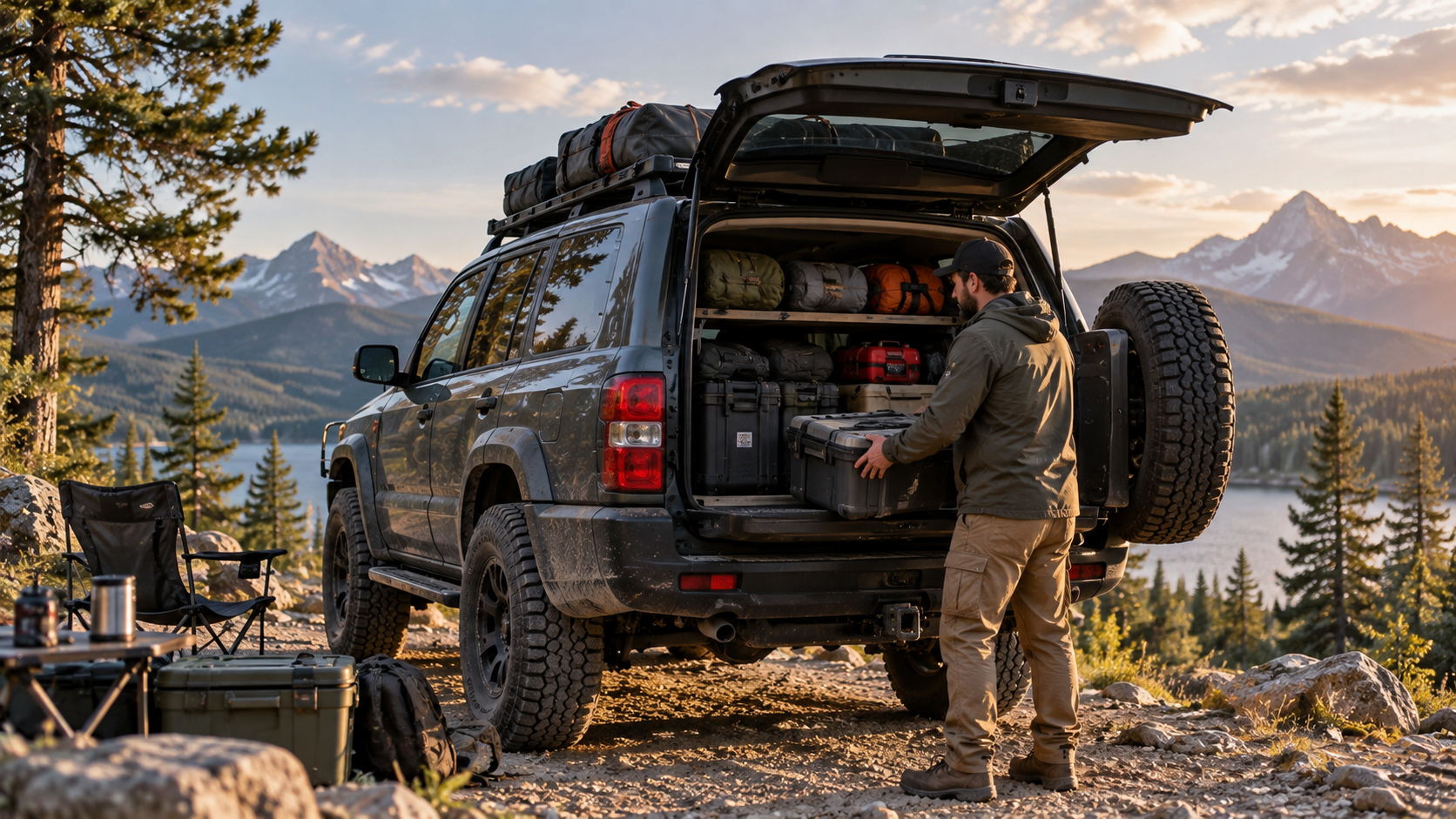
Packing an off-road vehicle is easy when the only question is whether everything fits. The harder question is what all that equipment does to the vehicle once the pavement ends. Recovery gear, water, tools, a fridge, spare parts, camping equipment, fuel, passengers, a roof rack and a full-size spare can add hundreds of pounds to a rig that felt perfectly balanced when empty.
That extra mass changes more than acceleration. Where you place it affects steering, braking, suspension travel, body roll, tire loading and the amount of traction available at each axle. A vehicle can remain technically within its total payload rating and still feel noticeably worse on a trail because too much weight is concentrated at the rear, mounted high on the roof, or stacked heavily on one side. Good loading is not about carrying as little as possible. It is about carrying what the trip requires while keeping the vehicle predictable.
Payload Is More Than the Gear in the Cargo Area
Drivers often think of payload as luggage, but the calculation is broader. Depending on how a manufacturer defines its published figures, the available payload may need to account for occupants, accessories and cargo rather than simply the boxes loaded before a trip. Permanent modifications matter too. A steel bumper, winch, skid plates, larger spare, drawer system, roof rack, auxiliary battery and other accessories all add weight before the first cooler or water container goes into the vehicle.
This is why an extensively equipped 4x4 may have considerably less usable capacity than expected. Start with the specifications for your exact vehicle rather than a generic number for the model family. Identify the applicable gross vehicle weight rating and axle ratings, then understand what the vehicle actually weighs in its normal trail configuration. A public vehicle scale is particularly useful for heavily modified rigs. Measuring the complete vehicle, ideally with separate front and rear axle weights where available, replaces assumptions with actual numbers.
Total Weight Is Only Half the Story
Imagine two identical vehicles carrying the same 400 pounds of additional equipment. In the first, dense equipment is stored low and relatively close to the middle of the vehicle. In the second, most of it sits behind the rear axle and on the roof. The scale may report the same total mass, but the two vehicles can behave very differently.
Manufacturers specify axle limits because total vehicle weight does not describe where the load is being carried. It is possible to remain below the overall vehicle limit while placing excessive load on one axle. Weight far behind the rear axle is especially important because it acts through leverage. It can increase rear axle load while reducing the proportion of weight carried at the front, affecting steering feel and balance. Do not ask only how much the gear weighs; ask where that weight is acting on the vehicle.
Put the Heaviest Equipment Low
One of the most useful principles for off-road packing is to keep dense items as low as practical. A vehicle’s center of gravity influences how much it leans as lateral forces increase. Adding weight high in the vehicle raises that center of gravity. The effect becomes especially noticeable on side slopes, during abrupt direction changes and when one wheel drops into a rut while another climbs an obstacle.
Good candidates for low storage include: Keeping these items low reduces their contribution to a high center of gravity and makes them easier to restrain safely. The lowest position is not automatically the best position, however. Weight still needs to be distributed between the axles and from side to side.
- Tools: Tool rolls, sockets, jacks and heavy repair equipment can add substantial concentrated weight.
- Recovery equipment: Shackles, recovery straps, winch accessories and dense hardware are usually better low than on a roof rack.
- Water: Large containers become surprisingly heavy when full and should be mounted securely.
- Spare parts: Components, fluids and heavy mechanical spares belong in stable storage.
- Batteries: Auxiliary batteries should use an appropriate engineered mounting location rather than being treated like loose luggage.
- Dense food and cooking equipment: Heavy boxes are easier on vehicle balance when positioned near the floor.
Avoid Turning the Rear Cargo Area Into a Counterweight
The space behind the rear seats is convenient, so it often becomes the default location for everything heavy. In pickups, the same problem occurs when dense cargo accumulates near the tailgate. This can make the rear suspension sag while unloading the front axle proportionally. Steering may feel lighter, the nose can respond differently to bumps, and the rear suspension has less travel available before reaching its limits.
The effect becomes more pronounced when accessories have already added permanent rear weight. A rear bumper, swing-out spare carrier, oversized spare, drawer system and auxiliary fuel can consume a meaningful portion of rear axle capacity before temporary cargo is added. When possible, move dense equipment forward within the cargo area rather than stacking all of it against the tailgate. Do not solve rear sag simply by installing stiffer springs and assuming the weight problem has disappeared; suspension changes do not automatically increase manufacturer-specified vehicle or axle ratings.
Treat the Roof as Premium Space, Not Spare Space
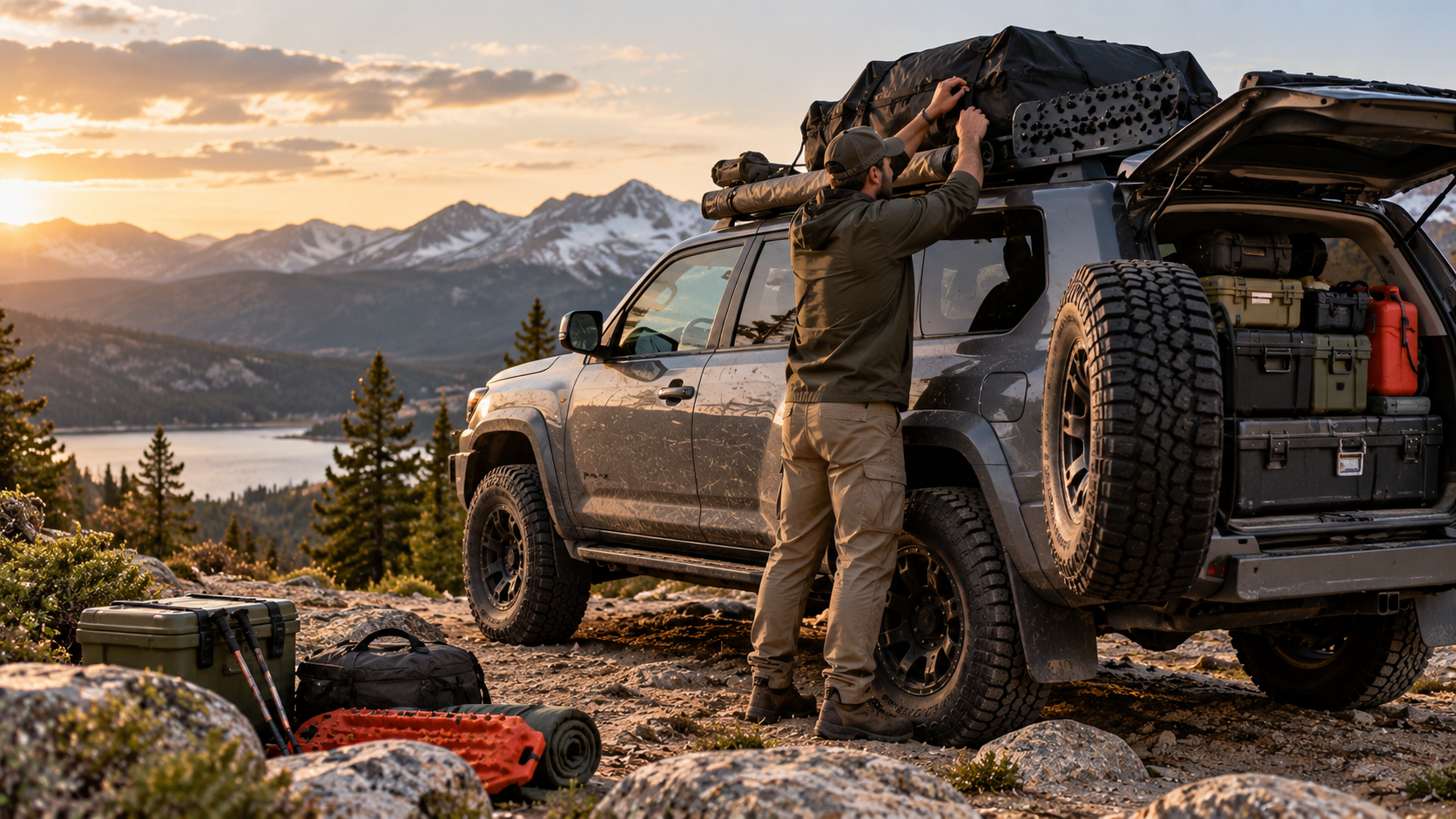
Roof racks create an appealing amount of storage, especially in vehicles with small cargo areas. The problem is that the roof is one of the most influential places to add weight. Every pound mounted above the cabin raises the combined center of gravity more than the same pound stored near the floor. As roof load increases, the vehicle can exhibit more body roll and feel less settled during quick steering changes. On off-camber terrain, that higher mass also reduces the stability margin.
Another common mistake is looking only at the rating printed on the roof rack. The rack, its mounting system and the vehicle roof may have different limits. Dynamic and static ratings also serve different purposes. A rooftop tent system may support occupants while the vehicle is parked yet have a much lower allowable load while the vehicle is moving.
Use this sequence before adding roof cargo: Light camp chairs and bulky soft goods are generally more sensible roof cargo than water, toolboxes or other dense equipment. If a heavy item can be carried securely lower without creating another distribution problem, that is usually the better location.
- Check the vehicle manufacturer’s applicable roof-load specification.
- Check the rack and mounting-system limits.
- Include the rack itself when required by the applicable specification.
- Account for rooftop tents, awnings and permanent accessories.
- Reserve remaining capacity primarily for lighter, bulky equipment.
- Secure every item to appropriate load points rather than relying on friction.
- Recheck fasteners and straps during long trips and after rough trail sections.
Recovery Gear Should Be Accessible Without Being Poorly Positioned
Recovery equipment creates a packing dilemma. Heavy equipment belongs low and secure, but it also needs to be reachable when the vehicle is stuck. A recovery kit buried beneath an entire campsite may be almost useless when the rear door is against a bank or the vehicle is sitting at an awkward angle.
Separate equipment by both weight and urgency. Dense hardware can live in a secured low compartment that remains accessible. Lighter recovery boards may be suitable for exterior mounting when the mounting system is designed for them. Think through likely recovery scenarios while the vehicle is parked at home: can you reach a strap without unloading five boxes, access a jack when one side is close to an obstacle, and reach essential equipment if the rear hatch will not open fully?
Secure Cargo as Though the Trail Will Be Rougher Than Expected
Cargo that slides around is not just annoying. Moving weight changes the vehicle’s balance dynamically and can damage equipment or injure occupants. A box that weighs 40 pounds while sitting still can generate much greater forces during a sudden stop, impact or rollover. Off-road driving adds repeated vertical and lateral movement that can loosen straps and shift containers over time.
Use suitable tie-down points and restraint systems. Heavy storage boxes should not depend on other luggage to keep them in place. Water and fuel containers need mounts designed for their size and mass. Drawer systems and refrigerators should be attached according to their manufacturers’ requirements. After the first rough section, stop and inspect the load because straps settle, soft bags compress and equipment can find space to move.
Do Not Pack Until the Suspension Looks Level
Visual stance is a poor loading gauge. A vehicle can appear level and still exceed an axle or overall weight limit. Aftermarket springs may hide visible sag while the tires, bearings, brakes, chassis and other components continue to carry the same mass. Use specifications and measured weight instead of appearance.
If the vehicle is permanently carrying significant accessories, suspension designed for the actual operating load can improve control and restore appropriate ride height. But suspension should be selected after understanding the weight problem rather than used to disguise it. This becomes especially important when a vehicle has been modified with skid plates and underbody armor, bumpers, winches and other protection. Each upgrade may be worthwhile, but together they reduce the payload remaining for people and trip equipment.
Tire Pressure Must Match the Loaded Vehicle and Terrain
Loading changes what the tires are being asked to support. That means the pressure that felt appropriate with an empty vehicle may not be appropriate after adding passengers and a full expedition load. There is no universal off-road pressure that works for every vehicle, tire and payload. The correct choice depends on tire construction, load, speed, terrain and manufacturer guidance.
Our guide to off-road tire pressure explains why pressures are adjusted for different surfaces and why copying another driver’s number is unreliable. Before a heavily loaded trip, confirm that the tires have sufficient load capacity and begin with appropriate road pressures for the actual load. Any reduction for off-road terrain should then be made deliberately, with speed and conditions taken into account.
A Practical Loading Order Before a Long Trip
Loading becomes easier when you follow the same sequence each time rather than filling empty spaces randomly. Start with permanent equipment and determine how much capacity it has already consumed. Then add passengers and trip-critical supplies before optional comfort equipment. Place dense cargo first so that its position is not dictated by whatever space remains at the end.
A useful packing sequence is: This order prevents convenience from determining weight distribution. If the final configuration is too heavy, remove or redesign equipment instead of searching for a way to squeeze it into the vehicle.
- Confirm vehicle, axle and roof limits for your configuration.
- Account for permanent modifications and accessories.
- Add expected passengers and essential supplies to the weight plan.
- Position heavy cargo low and close to the vehicle’s central area where practical.
- Balance dense equipment from side to side.
- Keep excessive mass away from the extreme rear.
- Add lighter bulky items after heavy equipment has a proper location.
- Use the roof only within applicable limits and preferably for lighter equipment.
- Secure every significant item before driving.
- Weigh the finished vehicle when the build or trip load is substantial.
Weigh the Rig in the Configuration You Actually Use
The most useful scale measurement is not an empty vehicle. It is the vehicle configured as closely as possible to the way it travels. Fill the fuel tank to the level normally used at departure. Install recovery equipment, tools, fridge, camping gear and other permanent or trip-specific items. Include occupants or account for their mass appropriately. If you normally carry significant water, include that as well.
Then measure total weight and, where possible, individual axle loads. The result can reveal problems invisible in a packing list. You may discover that the vehicle has plenty of total capacity left but very little rear axle margin, or that permanent modifications have consumed far more payload than expected. After major changes such as a new bumper, drawer system, rooftop tent, spare carrier or auxiliary tank, weigh it again.
Conclusion
A capable off-road rig can become surprisingly awkward when its cargo is loaded without considering weight distribution. Staying below the overall payload limit is only the beginning. Axle loads, roof limits, center of gravity, side-to-side balance and cargo restraint all influence how the vehicle steers, brakes and finds traction once the trail becomes uneven.
Keep dense equipment low and secure, avoid concentrating excessive weight at the extreme rear, treat roof capacity conservatively and account for the real mass of water, fuel, passengers and permanent modifications. Then weigh the vehicle in the configuration you actually use instead of relying on estimates. The best-loaded rig is not necessarily the one carrying the least equipment. It is the one carrying the equipment the trip genuinely requires in locations that allow the vehicle to remain stable, predictable and controllable when the terrain stops being easy.