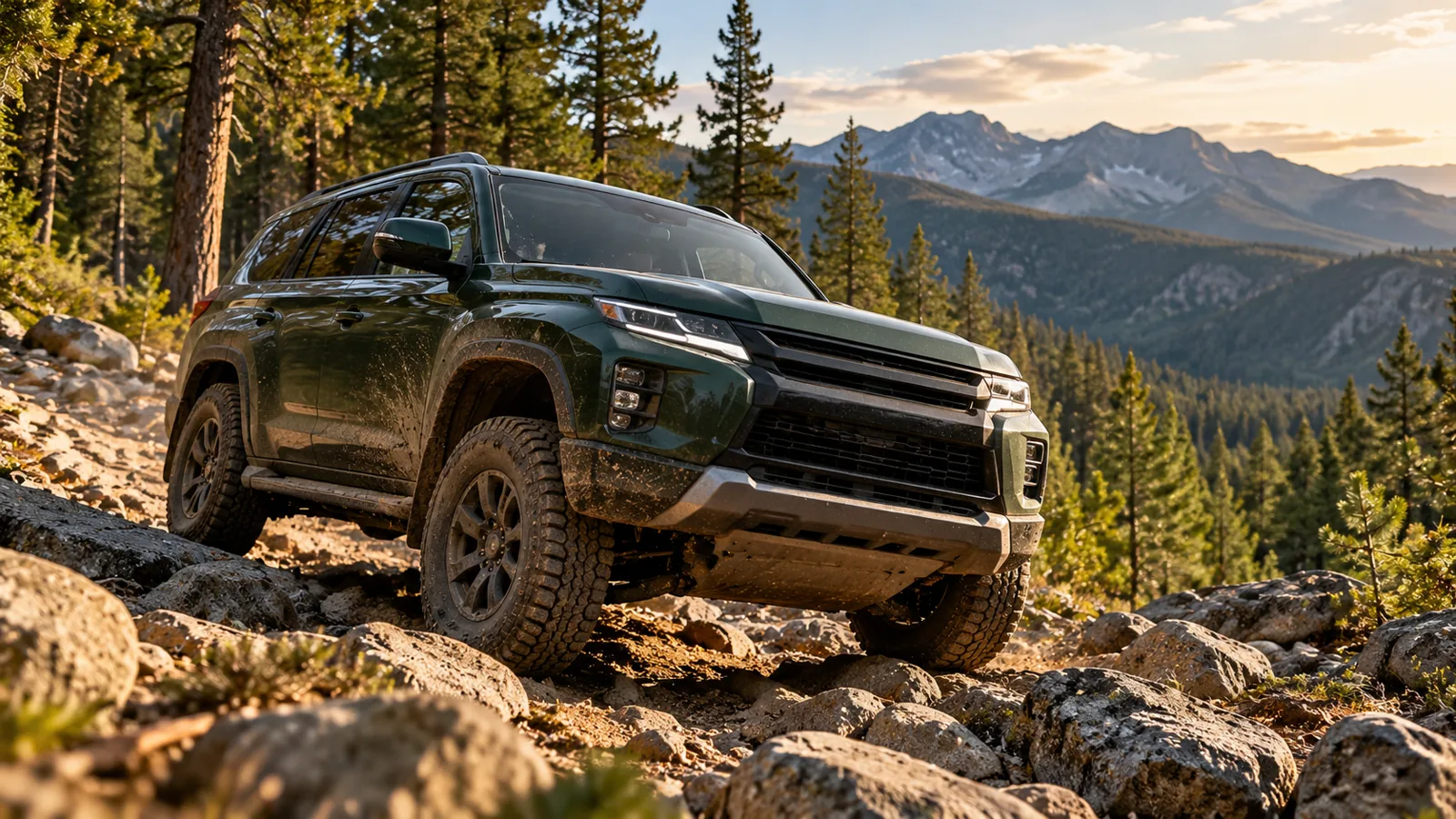
At a rutted turnoff, one SUV has low-range 4WD and another has AWD. Which is better? The answer depends on the terrain, the hardware, and how much low-speed control the driver needs. Here is how to compare the systems without relying on marketing shorthand, while keeping both vehicle safety and realistic trail conditions in mind.
The Difference Starts With How Torque Reaches the Ground
Four-wheel drive and all-wheel drive both describe systems that can deliver engine torque to the front and rear axles, but the badge alone tells you very little about how the vehicle behaves. The important details are whether the system can vary the front-to-rear speed difference, whether it has a low-range gear set, and how it reacts when one wheel loses grip. Two vehicles carrying a 4WD badge can be more different mechanically than a 4WD truck and an AWD crossover. Read the actual drivetrain specification rather than assuming the name guarantees a particular capability.
A typical part-time 4WD layout lets the driver use two-wheel drive on ordinary roads and engage a mechanically linked front axle when conditions require it. Many traditional systems offer a low-range setting that multiplies torque at low road speeds. An AWD system commonly uses a center differential or electronically controlled clutch to manage power automatically. Some AWD designs are permanent, some are on-demand, and a few include unusually capable terrain settings. These categories overlap, so the owner’s manual is the final authority on what your particular vehicle can do.
Powering four wheels cannot lift the underbody over a boulder or make a narrow track wider. The drivetrain helps use the grip available. Tire compound, pressure, suspension travel, clearance, and judgment determine how much of that potential becomes usable progress. This is why a vehicle with the right tires and a cautious driver can outperform a more expensive machine on the same trail.
How Part-Time 4WD Works on a Trail
In a conventional part-time system, selecting four-wheel drive connects the front and rear driveline through the transfer case. When the center connection is locked, the two axles cannot freely rotate at different average speeds. That can be helpful on loose ground where tires can slip slightly to release driveline tension. It can be a problem on high-grip pavement, where the front and rear wheels naturally travel different distances through turns. The resulting binding can make steering feel reluctant and place unnecessary stress on driveline parts.
Low range is often the feature that most clearly separates a trail-oriented truck from a road-focused crossover. It does not magically increase tire grip. Instead, the gearing lets the engine produce controlled wheel torque at a slower vehicle speed, so the driver can ease over rocks, manage a careful descent, or move a loaded vehicle without excessive throttle. Before using low range, check the vehicle-specific shifting procedure and the conditions under which the manufacturer permits each setting.
Not every 4WD vehicle uses a locked center connection in every four-wheel-drive mode. Mitsubishi’s Super Select 4WD-II, for example, has a road-compatible 4H mode as well as center-locked 4HLc and low-range 4LLc modes. Mitsubishi explicitly distinguishes these settings in its Triton owner’s manual. That distinction matters: blanket advice never to use 4WD on pavement is inaccurate, while using a locked center mode on dry pavement can still cause damage.
How AWD Manages Changing Grip
AWD systems generally aim to make changing road conditions easier for the driver. Depending on the design, a center differential, multi-plate clutch, or electronic control system varies how much torque reaches each axle. Wheel-speed sensors and traction-control software may intervene before a driver notices substantial wheelspin. On rain-soaked highways, snowy access roads, and ordinary gravel tracks, that unobtrusive operation is a major advantage because the driver can concentrate on steering and choosing a safe speed.
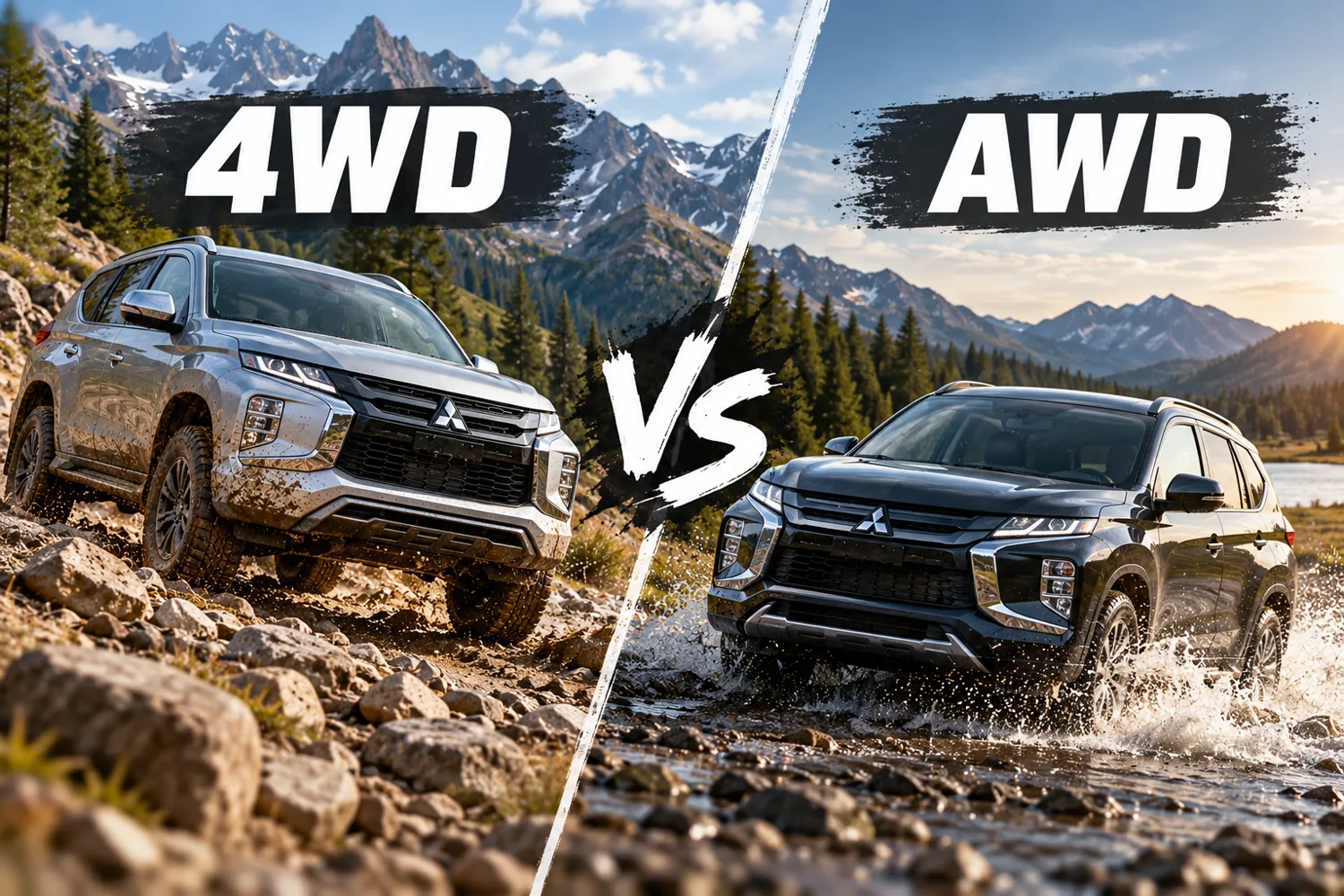
Many crossover AWD systems are not intended for prolonged wheelspin or severe rock crawling. A clutch-based unit may limit torque transfer as temperature rises. Street tires or limited clearance may stop a trip first. Some AWD vehicles are much more capable than the stereotype suggests, so evaluate gearing, tires, angles, and manufacturer guidance before making a judgment.
Automatic power distribution should never be mistaken for automatic judgment. On a slippery downhill grade, extra driven wheels do not create extra braking grip; the tires still have to work against the same surface. AWD can help a vehicle pull away on a slick road, but the driver still needs generous following distance and a speed appropriate for visibility and traction. The NHTSA tire safety guidance explains why tire choice must match the climate and the surfaces you actually drive.
What Matters More Than the Badge
If you are shopping for a vehicle that will leave the pavement regularly, start with the route instead of the drivetrain label. A maintained forest service road with occasional washboard requires a different setup from a rocky route with steps, deep ruts, and limited turnaround space. The former may suit a well-tired AWD crossover; the latter may call for low range, substantial clearance, underbody protection, and reliable recovery points. Choose a vehicle whose weakest component can handle the terrain.
Ground clearance must be considered together with approach, breakover, and departure angles. A vehicle can clear a shallow obstacle under its center yet scrape a bumper as it enters a dip. Long wheelbases can improve stability and cabin space but make crests more challenging. Before buying a suspension kit or oversized tires, review our guide to approach, breakover, and departure angles and decide which real obstacles the modification is meant to solve.
Tires are another major equalizer. A suitable all-terrain tire may give a vehicle more predictable behavior on loose gravel and rocky approaches than an aggressive drivetrain running worn highway tires. Tread pattern is only one part of the choice; load rating, sidewall construction, diameter, available clearance, and pressure management also matter. For a practical starting point, see our breakdown of choosing off-road tire size before committing to a fitment that compromises steering or rubbing clearance.
Compare the Systems Against Real Driving Conditions
For daily commuting in a wet or snowy region, an AWD crossover often offers the simplest ownership experience. The system can respond to variable grip without requiring the driver to remember when to engage a locked center mode. A 4WD truck may also work well, especially one with a road-compatible full-time setting, but it can bring more weight, larger tires, and different ride characteristics. There is no universal fuel-economy winner because vehicle size, gearing, aerodynamics, and tire selection vary so widely.
On rocky tracks with tall steps and uneven wheel loading, low-range gearing and a robust drivetrain are valuable because progress depends on precise low-speed control. An AWD vehicle with competent traction control can still negotiate mild obstacles, but an unprotected oil pan or vulnerable bumper may become the limiting factor. For deeper mud, wheel speed, tire tread, soil consistency, and recovery planning matter as much as torque distribution. Spinning harder when the vehicle stops moving can dig it into a worse position.
Sand creates a different set of demands. Soft sand rewards flotation, smooth throttle inputs, and a line that avoids sudden steering corrections. A heavy 4WD truck with inappropriate pressure can bog down just as readily as a lighter AWD crossover. Before a sand or gravel outing, understand when and how to air down tires, the limits of your tire and wheel setup, and the need to reinflate before returning to normal road speeds. Never use an arbitrary pressure copied from another vehicle.
A Practical Pre-Trip Drivetrain Checklist
You do not need an expensive build to start exploring easy trails, but you do need to know what the vehicle can and cannot do. Read the manual with the car parked, locate the relevant drive-mode controls, and learn what each warning light means. Check tire condition and the spare, inspect underneath for fluid leaks, and confirm that the planned route is open and legal. Bring a way to communicate when mobile coverage disappears, and tell someone where you intend to travel. Use the following sequence before committing to a route that is unfamiliar or remote. It focuses on decisions you can make in a driveway or at the trailhead, rather than on attempting risky maneuvers after a problem has developed.
- Identify the exact system. Confirm whether your vehicle has part-time 4WD, full-time 4WD, or AWD, and whether it has low range or a locking center differential.
- Match tires to terrain. Check tread, inflation, spare-tire condition, and the suitability of the tire for mud, snow, gravel, or pavement.
- Inspect the vulnerable parts. Look at clearance under the engine, exhaust, fuel tank, and bumpers before deciding that a route is appropriate.
- Plan a recovery option. Carry equipment you know how to use, identify approved recovery points, and avoid attaching a strap to an unverified component.
- Choose a turnaround point. Decide where you can safely stop and reverse your plan if weather, terrain, or vehicle behavior changes.
Once the checklist is complete, use the first easy section of trail to learn how the vehicle responds to modest changes in grip. If you hear binding, smell hot components, or see a drivetrain warning, stop somewhere safe and investigate rather than forcing progress. An enjoyable day off pavement should end with a vehicle that can still drive home, not with a test of how much punishment the transmission can survive.
Buying a Used AWD or 4WD Vehicle
A used vehicle can look ready for adventure while hiding the consequences of previous abuse. Fresh tires and clean paint do not tell you whether a transfer case has been overheated, whether a differential has run with contaminated fluid, or whether a crossover has repeatedly been driven through water deeper than its manufacturer permits. Start with a careful physical inspection, a test drive in the permitted road modes, and a review of service records. Have a qualified mechanic inspect the drivetrain and underbody before making a decision.
Ask the seller about modifications, towing, previous off-road use, and any repairs after water exposure or collisions. Confirm that all four tires are appropriately matched for the vehicle, because differences in rolling circumference can stress some AWD systems. A history check is useful alongside the mechanical inspection: cleanautohistory.com can be considered when researching a vehicle’s recorded background, but no history service can prove that every incident or mechanical fault has been documented.
Look underneath for crushed skid plates, bent mounting brackets, unusual corrosion, missing fasteners, and signs of recent sealing work around the drivetrain. During a supervised inspection, ask the mechanic to verify that selectable modes engage according to the owner’s manual and that warning lights are not being concealed. If the seller refuses an independent inspection, the safest decision may be to walk away rather than assuming a 4WD badge compensates for unknown maintenance.
Common Mistakes That Lead to Expensive Repairs
The first mistake is engaging a locked part-time four-wheel-drive mode on dry pavement and driving through tight turns. Driveline windup can cause hopping, difficult steering, and component stress. The opposite mistake is leaving a road-compatible full-time system unused because of an overly broad rule about 4WD vehicles. Manufacturer guidance should determine where each mode can be used.
The second mistake is assuming a more aggressive mode always creates more traction. Locking the center can help distribute torque between axles, but it cannot make a bald tire grip wet clay or guarantee steering control on ice. Selecting low range on a descent can improve low-speed control in appropriate vehicles, yet it does not replace safe speed selection, careful line choice, or a route assessment. If you need a refresher on gearing, our 4H versus 4L guide explains what the transfer-case settings actually change.
The third mistake is buying upgrades before identifying the limiting factor. Larger tires can alter effective gearing and increase stress on steering parts; a lift may change handling without delivering useful clearance under the differential. Before changing anything, drive easy routes, document where the vehicle struggles, and decide whether the issue is tire grip, gearing, ground clearance, driver experience, or recovery preparation. Money spent on appropriate tires and training often solves problems that expensive accessories merely disguise.
Which System Should You Choose?
Choose an AWD vehicle if most of your driving is on pavement and you occasionally travel maintained dirt roads, snowy access lanes, or easy gravel routes. Prioritize tires suited to your climate, sufficient clearance for the roads you use, reliable traction-control behavior, and a manufacturer-approved operating envelope. The convenience of automatic torque management is meaningful when the driving is varied but the terrain does not require crawling over large obstacles.
Choose a low-range 4WD vehicle if your plans include frequent rocky routes, deep ruts, demanding backcountry travel, or sustained low-speed driving with a loaded vehicle. Prioritize the actual transfer-case design, cooling, protection, recovery points, tire options, and the availability of service support. Some full-time 4WD systems bridge the gap between these categories, so a careful specification check can reveal options that suit both daily driving and serious trail work.
Ask instead: “What is the hardest route I will realistically drive, and what equipment does it demand?” A conservative route choice, good tires, a sound vehicle, and the willingness to turn around matter more than letters on the tailgate. Begin with easy trails before buying capability you may never need, and keep a record of the obstacles that actually limit your progress.
Conclusion
4WD and AWD are tools for different jobs, not competing promises of invincibility. Traditional low-range 4WD is often the better foundation for demanding off-road work, while AWD offers straightforward traction management for daily driving and light trails. Exceptions matter: road-compatible full-time 4WD systems, highly capable AWD designs, and poorly equipped 4WD vehicles can all upset a simple comparison. Verify the hardware, follow the manual, choose tires for the conditions, and keep the terrain within the vehicle’s real limits.
Before your next trip, inspect the route and the vehicle rather than relying on the drivetrain badge. Learn the available modes, carry a sensible recovery plan, and leave yourself an exit when the surface changes. A capable vehicle is valuable, but a driver who understands when not to proceed is the most important part of any successful off-road setup.