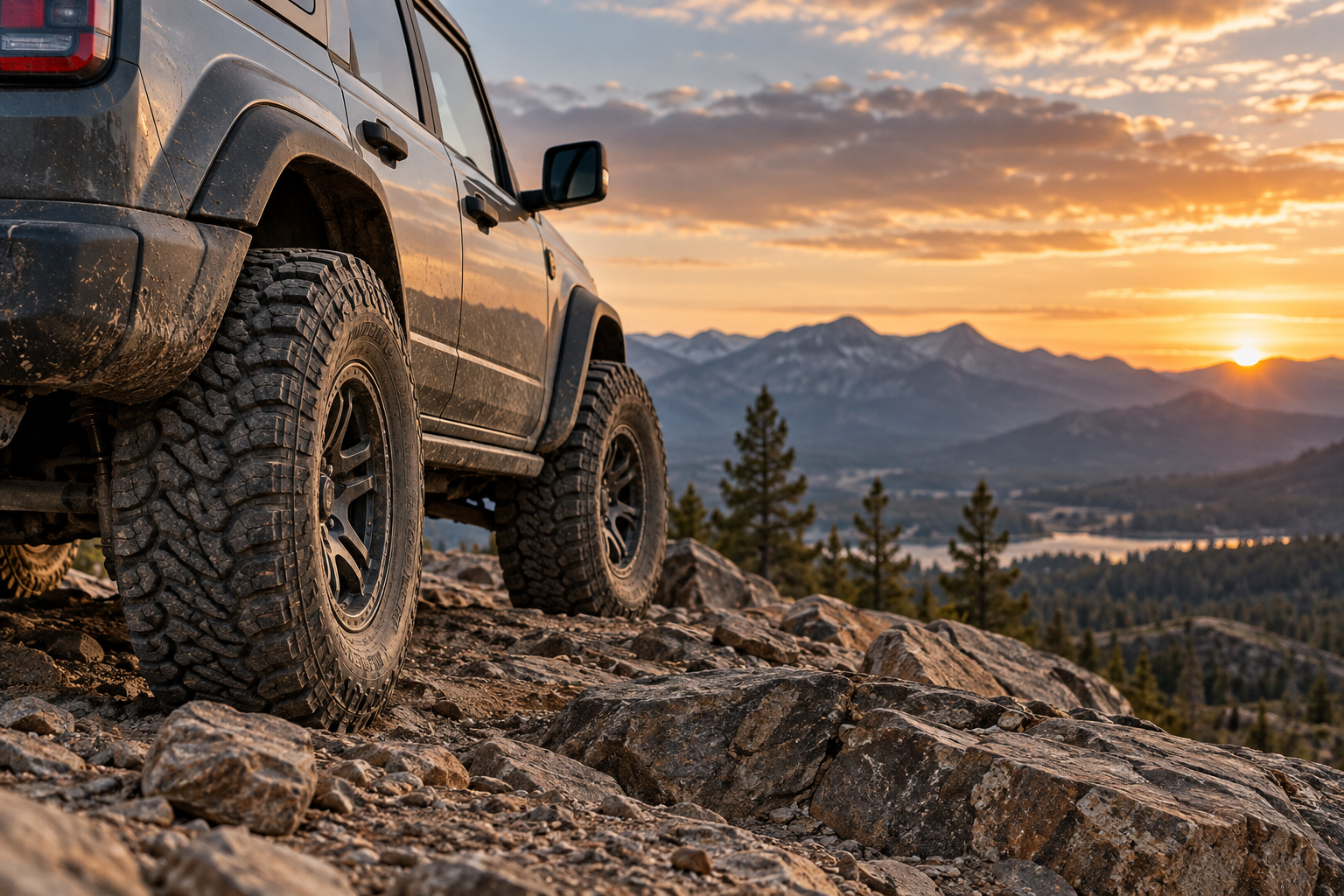
Bigger tires are one of the first upgrades many off-road drivers consider. They can add ground clearance under the axles, improve the ability to roll over rocks and ruts, and give a truck or SUV the stance people associate with a capable trail build. But tire size is also one of those modifications where going farther does not automatically mean going better.
A tire that looks perfect in a parking lot can make a vehicle noticeably less pleasant on the highway. Extra diameter and weight can change acceleration, braking, steering feel, gearing, fuel consumption, and the amount of space available inside the wheel well. Go too large without planning the rest of the build and you may end up fixing problems that did not exist before the tire upgrade.
The right size is therefore not the largest tire you can physically install. It is the largest size that provides a useful off-road advantage without creating compromises you are unwilling to live with every day.
Start With the Tire Size Your Vehicle Was Designed Around
Before looking at larger tires, establish a baseline. The original tire specification tells you what the vehicle manufacturer designed the suspension, brakes, steering, gearing, and electronic systems around. The recommended size can normally be found in the owner's manual and on the Tire and Loading Information label.
That does not mean you can never deviate from the factory size. Off-road vehicles are modified precisely because owners want capabilities beyond the stock configuration. But the original specification gives you a reference point for understanding how significant the change actually is.
The NHTSA TireWise guidance recommends checking the owner's manual or the Tire and Loading Information label when determining the correct tire size. Replacement tires also need appropriate load-carrying capability for the vehicle.
Before considering an upsized tire, write down these factory specifications:
- Original tire size.
- Wheel diameter and width.
- Recommended cold tire pressure.
- Tire load index or required load capacity.
- Speed rating where applicable.
- Available clearance around the stock tire.
- Whether the vehicle uses a full-size or temporary spare.
These numbers give you something concrete to compare against instead of choosing a new tire solely because another truck appears to fit it.
What Actually Changes When You Install a Bigger Tire?
A tire size change affects more than the distance between the axle and the ground. Increasing overall diameter changes the effective relationship between engine speed, gearing, and road speed. Increasing width changes the space required around the tire. Choosing a heavier tire adds rotating and unsprung mass.
This is why two tires that both technically fit the same wheel well can produce very different driving experiences. Construction, tread, load range, wheel choice, and actual tire weight matter alongside the size printed on the sidewall.
A modest increase may be barely noticeable on one vehicle. A much larger increase on another can make the engine feel less responsive and expose limitations in the stock suspension or gearing.
Ground Clearance Improves, but Not as Much as the Tire Number Suggests
Larger tires can increase clearance beneath the axles and differential housings. That is particularly valuable on vehicles with solid axles because a suspension lift raises the body and frame but does not directly move the differential farther away from the trail.
However, the increase in axle clearance is only about half of the increase in tire diameter. Moving from a tire that measures 31 inches in actual diameter to one that measures 33 inches adds roughly one inch of theoretical axle clearance, not two.
Actual installed measurements can also differ from the nominal size printed on the tire. Tire model, wheel width, inflation pressure, vehicle load, and manufacturer specifications can all influence the real dimensions.
If clearance is the main reason for the modification, our guide to how much ground clearance you actually need for off-roading explains why useful clearance depends on the terrain rather than simply chasing the highest possible number.
Effective Gearing Becomes Taller
A larger-diameter tire travels farther with each revolution. That effectively makes the vehicle's gearing taller.
On the highway, the engine may turn slightly fewer revolutions at a given actual road speed. That sounds beneficial, but the engine also has to overcome the leverage and mass of the larger tire. The result can be slower acceleration, more frequent transmission downshifts, and reduced control at very low trail speeds.
The difference becomes increasingly obvious as tire diameter moves farther away from the factory specification. Vehicles with modest engines or already-tall axle gearing tend to reveal the change sooner.
For a mild build, the effect may be acceptable. For a major jump in tire size, axle re-gearing may eventually become part of the project.
Why Tire Weight Matters Almost as Much as Diameter
Diameter gets most of the attention, but weight can transform the way a vehicle drives even when the size increase looks reasonable on paper. Aggressive all-terrain and mud-terrain tires often use stronger carcasses, deeper tread, and heavier construction than ordinary road tires. Larger aftermarket wheels can add even more mass.
Because that weight is part of the wheel-and-tire assembly, the suspension has to control it while the drivetrain has to accelerate it and the brakes have to slow it down. Tire Rack notes that significantly heavier wheel-and-tire combinations on trucks and SUVs can contribute to longer stopping distances and additional suspension and brake wear.
That is why comparing only dimensions can be misleading.
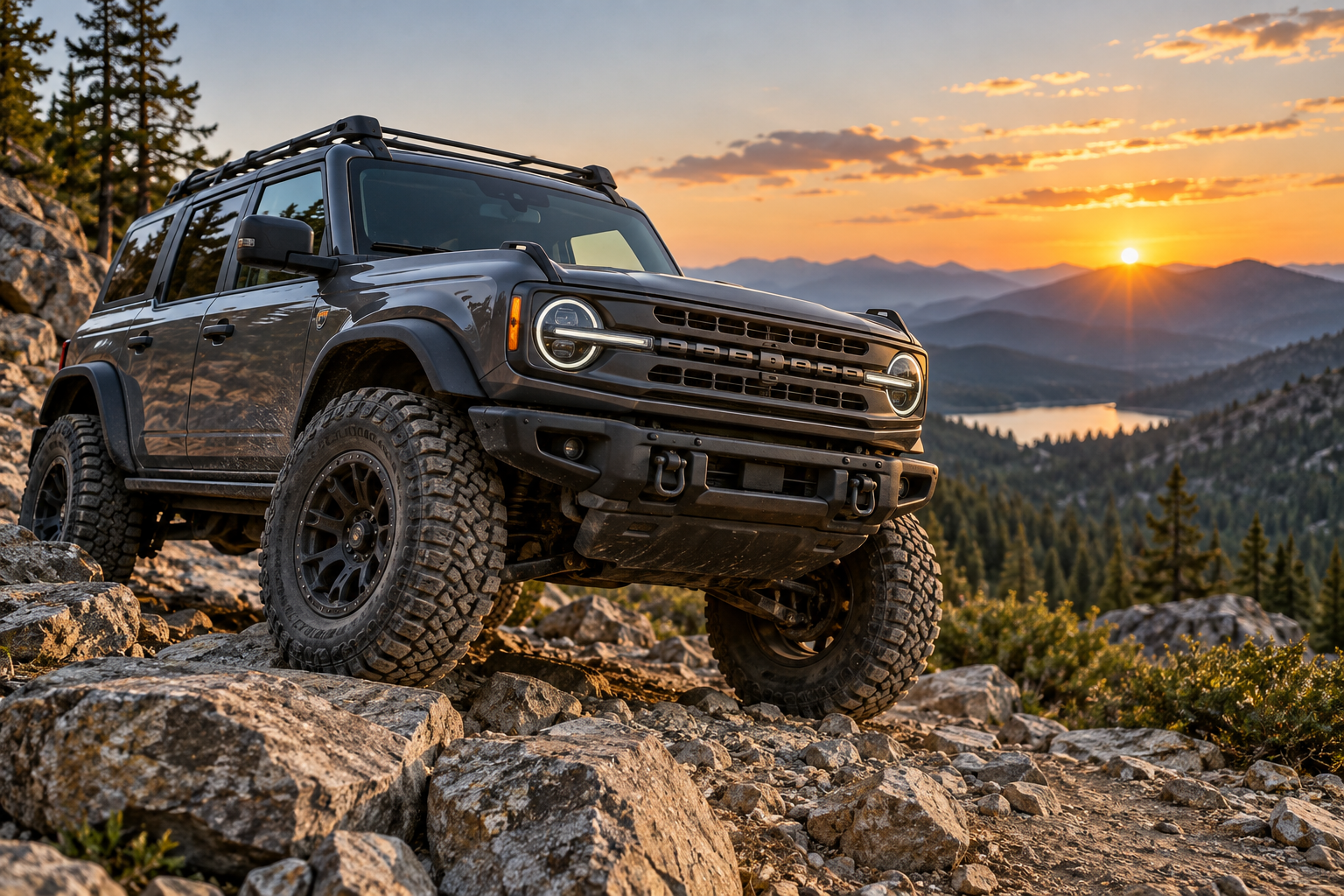
When comparing two possible tire setups, look at more than the advertised size:
- Compare the manufacturer’s actual overall diameter.
- Check the listed weight of each tire.
- Confirm the required load capacity and load index.
- Check the approved wheel-width range.
- Compare the weight of any new wheel with the factory wheel.
- Consider whether the extra strength of a heavier construction is actually necessary for your terrain and vehicle weight.
A lighter 33-inch setup can sometimes preserve daily-driver behavior better than an especially heavy 33-inch combination designed for severe use.
Will Bigger Tires Rub?
This is where a tire that “fits” can become a tire that does not really fit.
A vehicle parked on level ground represents only one suspension position. Off road, the wheels move upward and downward through their travel while the front wheels also turn. The tire has to clear suspension components, bodywork, liners, mud flaps, and other hardware throughout that range.
Width and wheel offset matter here just as much as diameter. Moving a tire outward may solve an interference problem on the inside while creating another problem at the fender. A wider tire can contact components that a taller but narrower setup avoids.
A proper fitment check should therefore consider full steering lock and suspension compression rather than whether the tire clears the fender while the truck is sitting still.
A Suspension Lift Does Not Automatically Solve Tire Clearance
It is easy to assume that installing a lift means a much larger tire will automatically fit. The relationship is more complicated.
Depending on suspension design, a lift can increase static clearance between the body and tire, but the tire still has to move through its usable suspension travel. Wheel offset, bump-stop position, alignment settings, control arms, and body geometry can continue to determine where contact occurs.
A lift should be chosen because the vehicle needs the additional suspension or chassis clearance, not simply because a tire-size chart says a certain height “requires” it.
If you are planning both modifications, read our guide on choosing the right off-road suspension lift height before treating tires and suspension as separate decisions.
Bigger Tires Can Change Braking and Steering Feel
A larger and heavier tire changes the work demanded from the vehicle's brakes. More rotating mass takes energy to accelerate and energy to slow down. Depending on the scale of the modification, the difference may range from difficult to notice to immediately obvious.
Steering can change as well. Wider tires, different wheel offset, heavier assemblies, and more aggressive tread can make steering feel heavier or less precise. Some setups also follow road grooves more noticeably than the factory tires.
These changes matter most on a vehicle that spends the majority of its life commuting, carrying family members, or traveling at highway speeds. Trail capability is useful, but predictable braking and steering are things you use every mile.
A build that is technically capable of running a large tire is not necessarily a build that remains enjoyable as a daily driver.
Speedometer and Electronic Systems Need Attention Too
When overall tire diameter changes, the relationship between wheel rotation and distance traveled changes with it. That can create a difference between indicated speed and actual road speed unless the vehicle can be recalibrated for the new tire size.
The issue is not limited to the number displayed on the dashboard. Modern vehicles can use wheel-speed information for systems such as ABS, traction control, stability control, transmission behavior, and other functions.
Tire Rack recommends maintaining an overall tire diameter close to the original specification when plus-sizing because substantial changes can affect speedometer accuracy and the operation of speed-dependent systems.
On a modified off-road vehicle, a larger overall diameter may be intentional. In that case, recalibration options and vehicle-specific compatibility should be investigated before purchasing the tires rather than after the dashboard starts behaving differently.
How Much Bigger Should a Daily-Driven Off-Road Vehicle Go?
There is no universal answer such as “33s are safe” or “35s are too big.” A 33-inch tire can be a mild upgrade on one truck and a substantial modification on another.
The useful question is how far the proposed tire moves the vehicle away from its original engineering baseline and what other changes are required to support it.
For a vehicle that sees significant pavement mileage, conservative sizing usually preserves more of the original driving behavior. The goal is to gain enough tire height and off-road construction to solve an actual trail limitation without creating a chain of unnecessary supporting modifications.
A sensible decision process looks like this:
- Identify the factory tire’s actual dimensions and load specification.
- Decide what problem the larger tire needs to solve.
- Compare one or two realistic larger sizes rather than jumping immediately to the biggest option.
- Verify actual tire diameter, width, weight, load capacity, and approved wheel width.
- Check clearance through steering and suspension travel.
- Determine whether speedometer or electronic recalibration is available.
- Consider whether the gearing and brakes remain appropriate.
- Decide whether the resulting highway compromises are acceptable for how often you actually drive off road.
If a tire upgrade forces you to accept several compromises without solving a real problem on the trail, it is probably larger than your build needs.
Match Tire Size to the Terrain You Actually Drive
Tire size should come after terrain and usage, not before them.
A vehicle that spends weekends on forest roads and moderate rocky trails may benefit more from a durable all-terrain tire in a conservative size than from an enormous mud-terrain tire. A rig regularly tackling deep mud, large rocks, or severe ruts may have a stronger reason to sacrifice some road manners for additional diameter and aggressive construction.
Tread type also changes the result. Two tires with similar dimensions can behave very differently because one is designed primarily for pavement and mixed use while the other prioritizes loose terrain.
Our comparison of all-terrain, mud-terrain, and hybrid tires can help narrow down the tire category before you decide how large that tire needs to be.
The important point is to build around your real driving. Do not choose tires for the hardest obstacle you might encounter once if doing so makes the vehicle worse during the other 99 percent of its mileage.
Do Not Sacrifice Load Capacity Just to Get the Size You Want
Fitment is not only about whether a tire physically fits under the vehicle.
The tire also has to safely support the load placed on it. USTMA states that replacement tires should use the size, load index, and speed-rating designation recommended by the vehicle or tire manufacturer and should not have a smaller load-carrying capacity than originally specified.
That becomes particularly important on off-road vehicles carrying recovery equipment, camping gear, armor, roof systems, passengers, spare fuel, or trailers. Accessories accumulate quickly, and the vehicle may already be operating much closer to its payload limit than an empty curb-weight figure suggests.
Never assume that a physically larger tire automatically has the correct load characteristics for your application. Verify the tire manufacturer's specifications for the exact model and size being considered.
Tire Pressure Still Matters After You Choose the Size
Installing larger off-road tires does not eliminate the need to manage pressure correctly. Pressure influences load support, heat generation, tread wear, handling, and the shape of the contact patch.
NHTSA advises drivers to use the vehicle manufacturer's recommended cold inflation pressure for the original tire configuration rather than simply inflating a tire to the maximum number printed on its sidewall. Once a vehicle has been substantially modified with non-original tires, determining an appropriate street pressure may require tire load data and qualified fitment guidance rather than blindly copying either number.
Off-road pressure is a separate issue again. Airing down can improve traction and ride quality on suitable terrain, but the appropriate pressure depends on tire construction, wheel setup, vehicle weight, speed, and trail conditions.
For the trail side of that equation, see our guide to when and how far to air down off-road tires.
Think About the Spare Before Buying Four New Tires
A larger tire can create a surprisingly basic problem: the spare may no longer match.
If the vehicle uses a full-size spare, check whether the new tire fits in the factory spare location. Underbody carriers, rear doors, cargo wells, and aftermarket bumpers all have physical limits.
You should also consider what happens if you have to drive with a significantly different-diameter spare. On some drivetrains, particularly certain AWD and 4WD systems, differences in rolling circumference can create operating concerns. Vehicle-specific guidance matters here, so the owner's manual should be checked before relying on a mismatched spare strategy.
If your build requires five matching tires instead of four, include that cost and extra weight in the plan from the beginning.
A Simple Way to Decide Whether the Upgrade Is Worth It
Imagine two versions of your vehicle.
The first gains enough clearance and traction to handle the trails you actually drive while remaining easy to accelerate, stop, steer, park, and commute in. The second looks more dramatic and gains additional theoretical capability but requires trimming, recalibration, heavier steering, more expensive tires, possible gearing changes, and additional supporting modifications.
For a dedicated trail rig, the second version may be exactly what you want. For a daily-driven vehicle, the first is often the more useful build.
The correct answer comes from deciding which compromises are acceptable before ordering the tires.
Conclusion
The best off-road tire size is not a number that works for every truck or SUV. It is a balance between clearance, traction, fitment, weight, gearing, braking, electronic compatibility, load capacity, and the amount of pavement driving the vehicle still needs to handle.
Start with the factory specification, define what you need the new tire to accomplish, and compare actual manufacturer dimensions rather than relying only on the size printed on the sidewall. Check the tire at full steering lock and throughout suspension travel, account for the spare, and understand what the added diameter and weight will ask from the drivetrain and brakes.
Going bigger can absolutely improve an off-road vehicle. Going only as big as the vehicle and its real use case justify is what keeps that improvement from turning into a daily compromise.