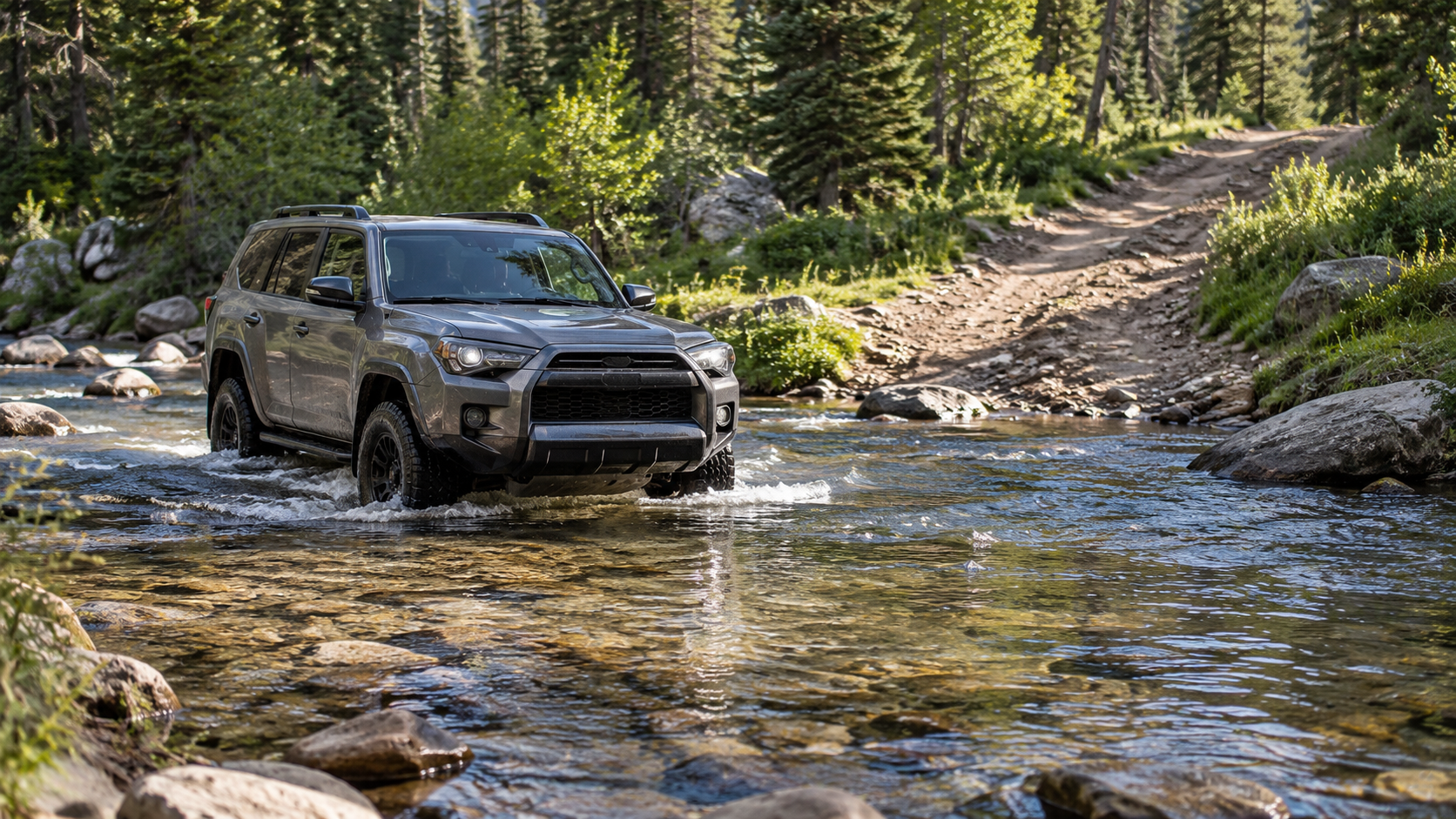
An off-road water crossing can look deceptively simple from the driver’s seat. The opposite bank may be only a few yards away, the surface may appear calm, and tire tracks disappearing into the water can make the route seem established. Yet water removes many of the visual clues you normally use to read a trail. You cannot easily see holes, loose rocks, submerged branches, soft mud, sudden changes in depth, or damage left by the vehicle that crossed before you.
That uncertainty is what makes water different from most other off-road obstacles. The goal is not to prove that your 4x4 can push through. It is to determine whether the crossing is predictable enough to attempt without exposing the vehicle, passengers, or environment to unnecessary risk. A safe decision starts before the tires touch the water: understand the crossing, know the limits of your vehicle, prepare a route to the opposite bank, and be willing to turn around when too many variables remain unknown.
Why Water Crossings Require More Caution Than They Appear
A rocky climb usually lets you see the obstacle before committing. A water crossing hides much of it. Clear water can distort perceived depth, while muddy water may conceal the bottom completely. A section that looks smooth from shore may contain a washed-out rut deep enough to drop one side of the vehicle unexpectedly.
Mechanical consequences can also be serious. Water reaching the engine intake can cause severe engine damage. Drivetrain components, electrical systems, brakes, bearings, and other parts may also be affected depending on the vehicle and the conditions. This is why the first question should never be “Can my 4x4 make it?” A better question is “Do I know enough about this crossing to attempt it safely?”
Start by Checking Your Vehicle’s Actual Wading Limit
Before heading onto a trail where water is expected, find the manufacturer’s stated wading depth for your exact vehicle, model year, configuration, and suspension setup. Do not rely on a number remembered from a forum, a video featuring a modified vehicle, or the capability of another SUV that happens to have similar ground clearance.
Maximum wading depth is a vehicle-specific engineering limit, not a universal target. Ground clearance and wading depth are also not interchangeable measurements. Ground clearance describes the space between the lowest relevant part of the vehicle and the terrain. Wading capability depends on much more, including the location of the air intake, electrical components, sealing, breathers, vehicle design, and manufacturer testing.
A lifted suspension therefore does not automatically mean the vehicle can safely drive through deeper water. Similarly, larger tires may raise parts of the chassis without changing the location or protection of vulnerable components enough to justify a substantially deeper crossing. Treat the published wading specification as a limit under appropriate conditions, not a depth you should deliberately seek on every trail.
Assess the Crossing Before You Enter
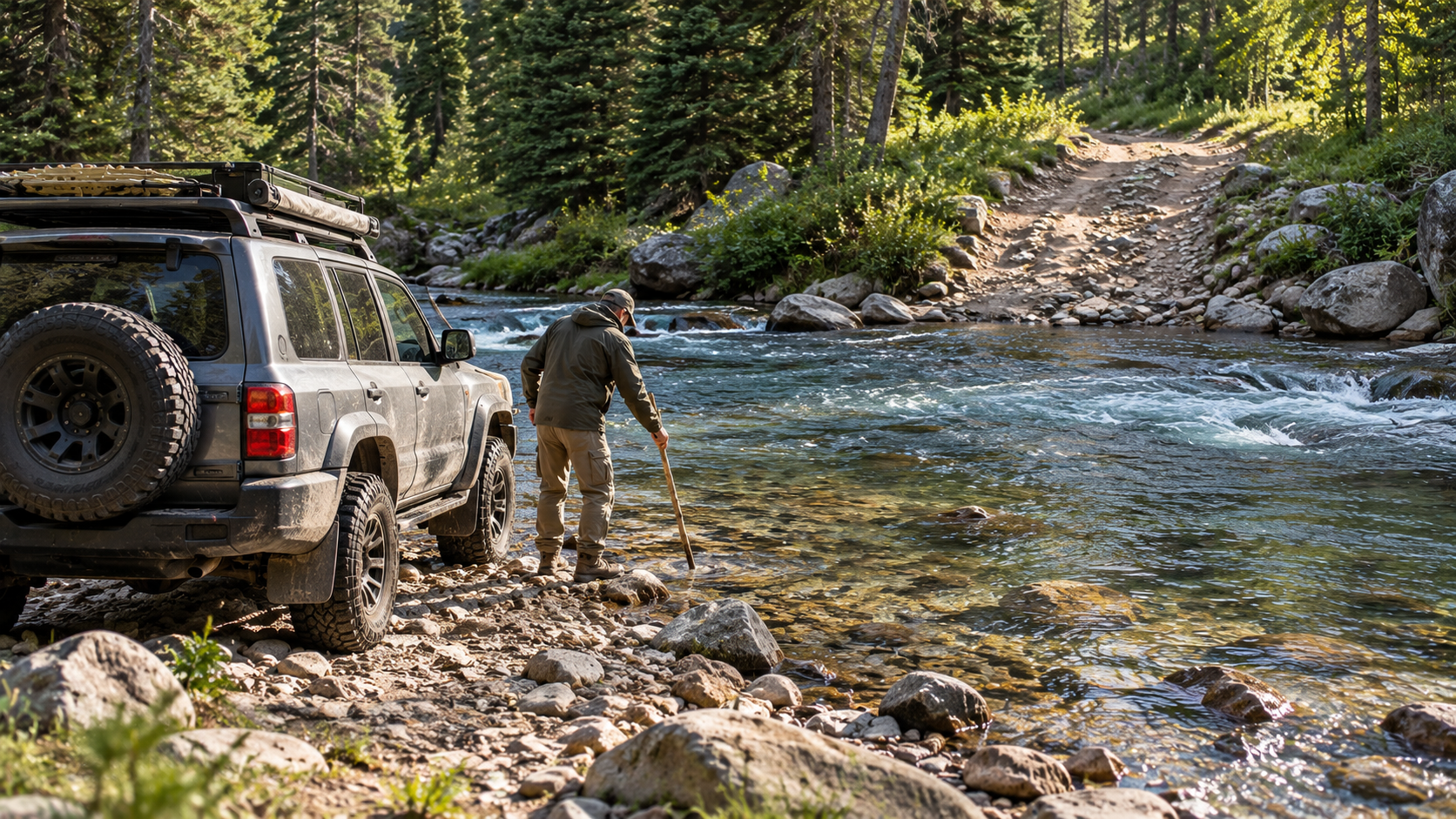
Stopping to inspect the water is one of the most valuable things you can do. Once the vehicle is committed, your options narrow quickly. From shore, you can take time to examine the approach, identify possible hazards, and decide whether another route is smarter.
- Before driving into an unfamiliar crossing, evaluate the depth along the entire planned line, the speed and direction of the current, the bottom surface, the entry angle, the far-bank exit, hidden obstacles, and recent weather.
- Look at floating debris, ripples, vegetation, and water moving around rocks.
- A firm gravel bottom is very different from soft mud, and a gradual exit is very different from an eroded ledge.
Walking an unfamiliar crossing can help gauge depth and reveal submerged obstacles only when conditions make doing so safe. If the current is too strong to stand comfortably, the bottom cannot be evaluated safely, wildlife presents a risk, or you simply cannot determine what lies beneath the surface, you do not need to investigate further to justify turning around. A crossing does not become safer because you feel committed to the route.
Depth Is Only One Part of the Decision
Current can move the vehicle sideways. Soft sediment can increase rolling resistance and bury tires. Large submerged rocks can alter wheel position suddenly. A steep exit may require more traction just as the vehicle is carrying water, mud, and reduced braking performance. The safest crossing is the route where depth, flow, bottom condition, approach, exit, and vehicle capability combine to create the most predictable path. If several of those factors remain unknown, uncertainty itself becomes a reason not to enter.
Know Where Your Engine Takes In Air
Water entering an engine through its air intake can cause catastrophic damage. Unlike air, liquid water does not compress normally inside a combustion chamber. Attempting to restart an engine that has stopped after ingesting water can make the damage worse. That makes intake height and intake routing important pieces of the preparation process.
A properly installed snorkel can raise the point from which an engine draws air and reduce the likelihood of water entering through the normal intake during suitable crossings. However, a snorkel should not be treated as permission to ignore the rest of the vehicle. Raising the air intake does not automatically waterproof electronics, drivetrain breathers, seals, alternators, starter motors, cooling fans, or other components. If you frequently travel through water, preparation needs to be considered as a complete system rather than a single accessory.
Prepare the Vehicle Before Entering the Water
Once you have inspected the crossing and determined that it is appropriate for your vehicle, stop on dry ground and prepare before moving forward. This is not the place to discover that recovery equipment is buried beneath luggage or that you selected the wrong drive setting after the front wheels are already submerged.
Your exact setup will depend on the vehicle. Some 4x4s have traditional selectable low range, while others rely on electronically controlled terrain modes or different four-wheel-drive systems. Use the procedure specified for your model rather than assuming every SUV operates the same way. If your vehicle provides selectable 4H and 4L, understanding when and how to use 4H and 4L before reaching an obstacle makes these decisions much easier.
A practical sequence before entering is: Preparation should make the actual crossing uneventful. If you are still improvising while entering the water, you entered too soon.
- Confirm the planned depth.
- Select the appropriate drive range or terrain mode.
- Engage relevant traction equipment before entering.
- Secure loose cargo.
- Make recovery equipment accessible.
- Establish the line from entry to exit.
- And identify where steering corrections may be needed.
Use a Controlled, Steady Pace
Once committed, smoothness matters more than aggression. Enter gently rather than charging into the water. Excessive speed creates a large splash that can push water high into the engine bay and reduce visibility. It can also make hidden rocks or holes much harder to manage. At the other extreme, crawling so slowly that the vehicle loses momentum on a soft bottom can create its own problems.
The objective is a controlled, consistent pace appropriate for the vehicle and crossing. Keep steering inputs deliberate. If you already inspected the route, you should know approximately where the tires need to go. Sudden steering changes can move the vehicle off the firm line and into deeper water or softer ground. A modest bow wave may form ahead of the vehicle at the correct pace, but a dramatic wall of spray is not evidence of better technique.
Do Not Rely on the Vehicle Ahead of You
Watching another 4x4 cross can provide useful information, but it does not prove that the same line is safe for your vehicle. The other vehicle may have greater wading capability, taller tires, a different intake location, lockers, different weight distribution, more suitable tires, or an experienced driver who knows the obstacle. Its passage can also disturb the bottom, deepen ruts, or move rocks.
What If You Lose Traction Mid-Crossing?
A loss of traction is one reason your assessment of the bottom matters so much. Mud, loose gravel, and submerged rocks can reduce grip unexpectedly. Avoid responding with an immediate burst of throttle. Excessive wheelspin can dig the tires deeper into soft material and make recovery more difficult. Instead, remain calm, evaluate whether the vehicle still has controlled movement, and use the traction systems available to you according to the manufacturer’s instructions.
A locking differential can be valuable in low-traction terrain because it can help maintain useful torque delivery when wheel grip differs significantly across an axle. But the equipment does not replace line choice or good judgment. If the vehicle becomes stuck, a recovery plan prepared before entering is far safer than improvising with water around the vehicle. Use properly rated recovery points and equipment and keep people away from loaded straps or winch lines.
What to Do If the Engine Stalls in Water
An engine that stops during a water crossing creates a very different situation from a simple loss of traction. Do not repeatedly crank the engine without understanding why it stopped. If water may have entered the intake, attempting to restart can turn a recoverable situation into major internal engine damage.
Focus first on passenger safety and controlled vehicle recovery. The appropriate method depends on the location, water conditions, vehicle position, available equipment, and whether another capable vehicle is present. Once the vehicle is on safe ground, determine the cause before attempting to run it again. If water ingestion is suspected and you do not have the experience to inspect the engine properly, professional assistance is the safer choice.
Check the Vehicle After You Reach Dry Ground
Reaching the opposite bank is not the end of the crossing. Brakes can behave differently immediately after being submerged. Mud, stones, vegetation, and other debris can collect underneath the vehicle. Water can also enter components without creating an immediate symptom. Once safely clear, check brake response carefully at low speed, inspect the underbody for trapped debris, watch for warning lights or unusual electrical behavior, listen for new mechanical noises, inspect the air filter or intake if water came unusually high, and check relevant drivetrain fluids when contamination is possible. After a particularly deep crossing, or if you regularly drive through water, more thorough inspection and maintenance may be appropriate. Milky or cloudy lubricant can indicate water contamination and should not be ignored.
When Turning Around Is the Right Off-Road Decision
Good off-road driving is largely about recognizing when the available information does not support continuing. Turn around when the water exceeds or approaches your vehicle’s known capability, the current is strong, you cannot determine the bottom, the exit is badly eroded, the water is rising, the route would require stopping in deep water, you lack appropriate recovery equipment, or you are travelling alone where a failed crossing could become an emergency.
Weather deserves particular attention. A creek that was easy earlier in the day can change after rain upstream, sometimes before local weather makes the cause obvious. No trail destination is important enough to justify entering water that you cannot reasonably evaluate. Choosing another route is not a failed attempt. It is exactly the kind of decision that keeps both the vehicle and its occupants available for the next trip.
Build Water-Crossing Skill Gradually
If you are new to off-roading, your first water crossing should not be a deep river with an uncertain bottom. Start with shallow, slow, predictable water where you can concentrate on reading the terrain, controlling speed, and learning how the vehicle responds. Understanding the rest of your setup helps as well. Correct tire pressure for off-road driving can influence traction and tire behavior on the approaches and exits, while knowing your vehicle’s ground clearance helps you evaluate rocks, ruts, and abrupt changes in the submerged trail. Over time, you learn to recognize how current behaves around obstacles, how different bottoms affect steering resistance, and how your vehicle feels when traction changes.
Conclusion
Off-road water crossings demand a different mindset from ordinary trail obstacles because the most important hazards are often hidden. A safe crossing begins with knowing your vehicle’s actual wading capability, inspecting the depth and current, understanding the bottom and exit, and preparing the drivetrain and recovery equipment before entering.
Once committed, use a smooth, controlled pace and avoid unnecessary changes in speed or direction. After reaching dry ground, check the brakes, underbody, intake, and other vulnerable components rather than assuming that reaching the opposite bank means the vehicle is unaffected. Most importantly, remember that turning around is always an available option. Water depth, current, weather, trail erosion, and vehicle capability can change the risk equation quickly. When the crossing cannot be evaluated with reasonable confidence, finding another route is usually the most capable decision you can make.